
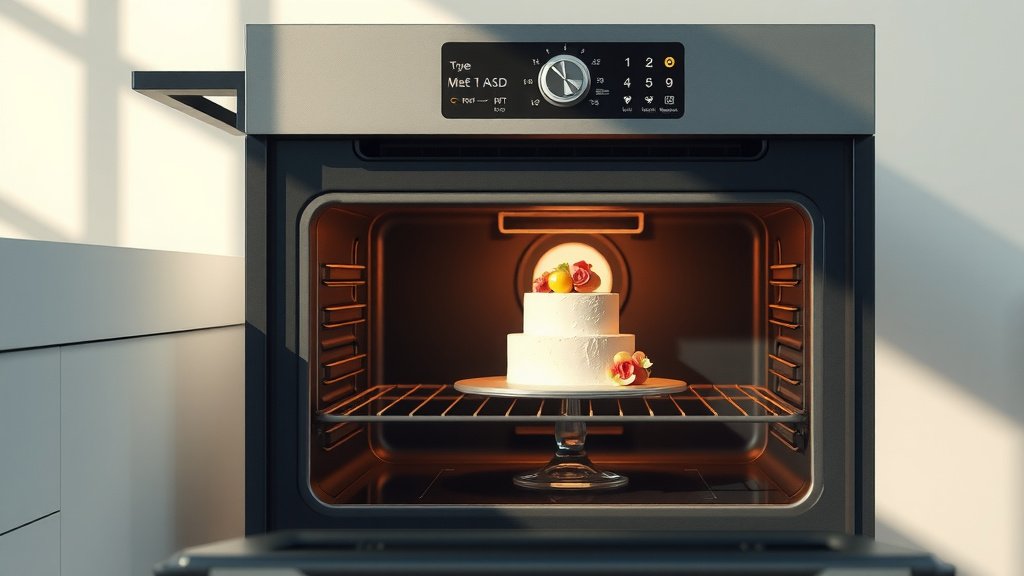
For consistently baked cakes with even browning, a convection oven is often preferred due to its fan-driven heat distribution.
While conventional ovens can bake delicious cakes, convection ovens minimize hot spots and reduce baking time, making them a strong contender for optimal cake results.
- A convection oven typically bakes cakes more evenly and faster than a conventional oven.
- The fan in a convection oven circulates hot air, which helps to prevent hot spots and ensures consistent browning.
- You might need to adjust baking times and temperatures when using a convection oven for cake recipes.
- For delicate cakes, a conventional oven’s gentle heat can be less drying, but convection usually produces a better rise.
- Ultimately, understanding your oven and making slight adjustments leads to delicious cake results, no matter the type.
Which Oven Type Is Better For Baking Cakes?
When it comes to baking cakes, many home bakers wonder if their oven choice truly matters. We found that both conventional and convection ovens can bake wonderful cakes, but they achieve this through different methods.
Understanding Oven Basics: Conventional vs. Convection
Let’s talk ovens for a moment. You mainly have two types in home kitchens: conventional and convection. Knowing the difference helps you pick the best tool for your baking task.
The Conventional Oven: Your Traditional Baker
A conventional oven, also called a thermal oven, uses heating elements at the top and bottom. Heat radiates from these elements, warming the air inside. This means the heat can be uneven, with hotter spots near the elements (Baking Science Research).
The Convection Oven: A Modern Approach
A convection oven adds a fan, usually at the back. This fan circulates the hot air throughout the oven cavity. This forced air movement is designed to create a more consistent and even temperature around your food.
Why Even Heat Matters for Perfect Cakes
Imagine baking a cake. You want it to rise beautifully, bake through evenly, and brown nicely on top. Hot spots in an oven can cause some parts of your cake to cook faster, leading to a domed top or dry edges. Even heat ensures a consistent, tender crumb.
Convection Ovens and Cake Baking: The Pros
Many experts say convection ovens are a baker’s best friend, especially for cakes. We found several reasons why they often get the nod. They provide a superior baking environment for many recipes.
Faster Baking Times
Because the hot air is constantly moving, it transfers heat to your cake more efficiently. This often means your cakes will bake quicker, sometimes by as much as 25% faster than in a conventional oven (Culinary Institute of America). Keep an eye on your cake to prevent overbaking.
Even Browning and Texture
The circulating air ensures that all surfaces of your cake are exposed to the same temperature. This results in a beautiful, even golden-brown crust and a uniformly tender texture throughout the cake. No more burnt edges and pale centers.
Reducing Hot Spots
One of the biggest advantages of convection is its ability to eliminate those annoying hot spots. The fan distributes heat, so you don’t have to worry about one side of your cake baking faster. This means less rotating and more consistent results.
Challenges with Convection for Cakes
While convection offers many benefits, it isn’t always a simple switch. There are a couple of things to watch out for to ensure your cakes turn out perfectly. It requires a slight learning curve.
Potential for Drying Out
The constant airflow can sometimes dry out delicate cake batters if not properly managed. Some bakers find that the edges can become a bit crispier. We recommend adjusting the temperature or baking time to counteract this.
Adjusting Recipes
Most cake recipes are written for conventional ovens. If you’re using a convection oven, you’ll often need to make adjustments. A common practice is to lower the temperature by 25°F (about 15°C) or reduce the baking time (Food Network Kitchens).
Conventional Ovens and Cake Baking: Their Strengths
Don’t count out your trusty conventional oven! It has been baking delicious cakes for generations. Many home cooks still achieve perfect results with these ovens, showing their reliability.
Gentle, Consistent Heat
For very delicate cakes, like cheesecakes or soufflés, some bakers prefer the gentler, still air of a conventional oven. This less intense heat can help these sensitive items rise slowly and prevent cracking or drying. It’s about finding the right environment for specific treats.
No Need for Recipe Adjustments
If you’re following a recipe exactly as written, a conventional oven often requires no special adjustments. You can just set the temperature and time as directed, making it very straightforward. This offers a familiar and easy baking experience.
Making Your Decision: What to Consider
So, which oven is truly better for you? The answer often depends on your personal situation and baking style. Think about what you bake most often and what features matter to you.
Your Baking Habits
Do you bake frequently, or only on special occasions? If you’re a serious baker, the consistency of convection might be worth the investment. For occasional bakers, a reliable conventional oven might be all you need.
Type of Cakes You Bake
Are you mostly making sturdy sheet cakes or delicate angel food cakes? Convection excels with denser batters. However, if you bake many delicate items, a conventional oven’s gentle heat might be more suitable. Consider the specific needs of your recipes.
Budget and Space
Convection ovens can sometimes be more expensive, and some combination models require more space. Consider your kitchen layout and how much you’re willing to spend. A good oven is an investment in your culinary adventures.
Getting the Best from Any Oven
No matter which oven you have, you can achieve fantastic cake results with a few smart practices. It’s less about the oven type and more about understanding your specific appliance.
- Always preheat your oven fully.
- Use an oven thermometer to verify accuracy.
- Rotate your cake halfway through baking in a conventional oven.
- Avoid opening the oven door too often.
- Know when to use parchment paper or baking spray.
- Check for doneness with a toothpick, not by eye alone.
| Feature | Conventional Oven | Convection Oven |
|---|---|---|
| Heat Distribution | Radiant, can have hot spots | Fan-forced, very even |
| Baking Time | Standard (recipe time) | Faster (reduce by 25%) |
| Browning | Can be uneven | Consistent and even |
| Drying Potential | Lower | Higher for delicate items |
| Recipe Adjustments | Usually none needed | Often requires temp/time reduction |
| Best For | Delicate custards, soufflés | Most cakes, cookies, roasting |
Conclusion
When it comes to baking cakes, a convection oven generally offers a slight edge due to its even heat distribution and faster cooking times. It minimizes hot spots and provides consistent browning, which are key for a perfect cake. However, you’ll likely need to adjust recipes slightly, lowering the temperature or shortening the bake time.
A conventional oven is still perfectly capable of producing delicious cakes, especially for those delicate recipes that benefit from still, gentle heat. Ultimately, the best oven for baking cakes is the one you understand best. By knowing your oven’s quirks and making small adjustments, you can bake amazing cakes every time, regardless of its type.
What is the main advantage of a convection oven for cake baking?
The main advantage is its fan, which circulates hot air for even heat distribution. This means your cakes bake more uniformly, with less chance of hot spots, leading to a consistent texture and better browning.
Do I always need to adjust recipes for a convection oven?
Yes, it’s generally a good practice to adjust recipes written for conventional ovens. Many bakers reduce the temperature by 25°F (about 15°C) or shorten the baking time by 10-25% to account for the more efficient heat transfer.
Can I bake multiple cakes at once in a convection oven?
Yes, one of the benefits of convection ovens is that you can often bake multiple items on different racks without needing to rotate them. The circulating air ensures even cooking throughout the oven cavity.
Are there any cake types that are better suited for conventional ovens?
Some very delicate cakes, like cheesecakes or certain custards, might benefit from the still, gentler heat of a conventional oven. This helps prevent cracking on top and excessive drying.
How can I make my conventional oven bake cakes more evenly?
To improve evenness in a conventional oven, always preheat fully, use an oven thermometer to verify temperature accuracy, and rotate your cake pans halfway through the baking time to compensate for hot spots.
