
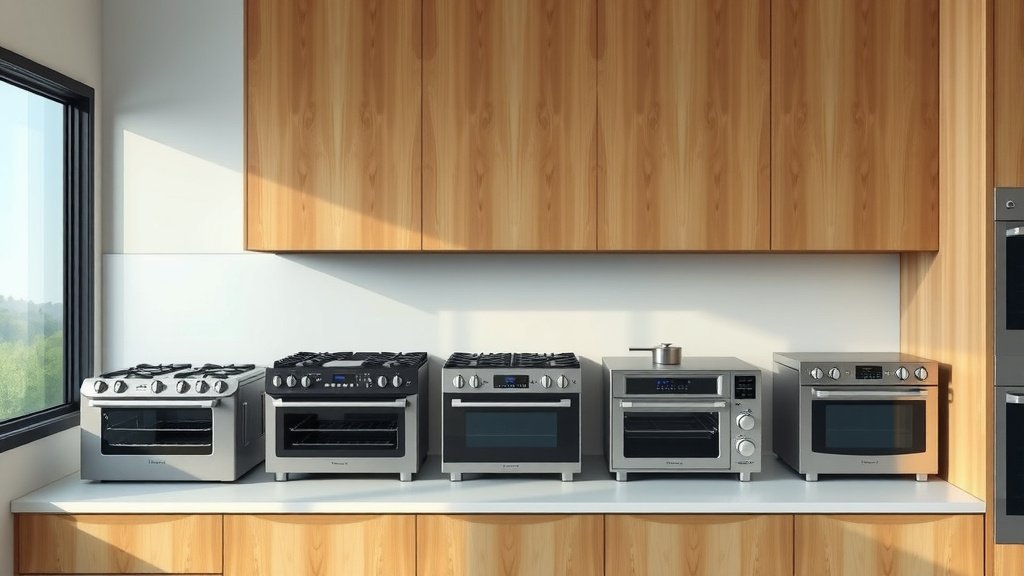
For the most precise temperature control in an oven, a high-quality convection oven often provides superior accuracy and consistency compared to conventional models.
While various factors play a role, research often indicates that advanced convection ovens with multiple heating elements and precise fan controls excel in maintaining stable temperatures.
- High-quality convection ovens generally offer the best temperature precision.
- Smart ovens with advanced sensors are catching up, providing excellent control.
- Conventional ovens can be precise but often have wider temperature swings.
- Combi ovens use steam, which helps with even heat distribution and stability.
- Regular calibration and using an external thermometer are key for any oven.
Which Oven Type Has Most Precise Temperature?
We found that modern convection ovens generally provide the most precise temperature control for home cooks and bakers.
Why Does Oven Temperature Precision Matter So Much?
Have you ever wondered why your cookies sometimes burn on one side or your roast cooks unevenly? It often comes down to temperature accuracy.
Precision is not just a fancy word; it dictates whether your soufflé rises perfectly or collapses into a sad mess. It also affects how food browns and the texture it develops (Good Housekeeping Institute).
When an oven maintains its set temperature closely, your recipes have a much better chance of turning out as intended. This means more consistent results every time you cook.
Conventional Ovens: The Basics of Heat
Most homes have a conventional oven, heated by elements at the top and bottom. Heat radiates and circulates naturally inside the cavity.
While simple, these ovens can have noticeable hot and cool spots. This variation happens because heat distribution isn’t actively managed beyond those heating elements.
You might find that your conventional oven can be off by 10 to 25 degrees Fahrenheit from its set temperature (Consumer Reports).</ This means your "350°F" could actually be 330°F or 375°F at times.
Convection Ovens: Airflow for Accuracy
A convection oven adds a fan to circulate hot air evenly throughout the oven cavity. This constant motion of air significantly reduces hot and cold pockets.
Many experts say this active air circulation is the secret to more consistent temperatures (USDA). It ensures that every part of your food experiences the same heat.
While it improves uniformity, it doesn’t always guarantee absolute pinpoint precision to the degree. However, it does mean the temperature you set is more consistently delivered across your dishes.
True Convection vs. Standard Convection
Some ovens offer “true convection” or “European convection.” This means they have a third heating element around the fan itself.
This dedicated heating element ensures the circulated air is already hot when it enters the oven space. It provides an even more uniform and stable temperature than standard convection.
When you’re looking for precision, a true convection system is often a significant upgrade. It really helps eliminate those pesky temperature fluctuations.
Smart Ovens and Advanced Sensors: The Digital Edge
Modern smart ovens often come equipped with multiple temperature sensors and sophisticated digital controls. These ovens can monitor and adjust heat more rapidly.
The internal computers work to minimize temperature swings, reacting quickly to maintain your desired setting. This often leads to exceptional precision.
Some smart ovens even learn your cooking habits and can preheat more efficiently. Their advanced tech makes them strong contenders for top temperature accuracy.
Combi Ovens: Steam for Stability
Combi ovens combine conventional heat with steam. The introduction of steam into the cooking environment can also lead to incredibly even temperatures.
Steam helps transfer heat more efficiently and prevents food from drying out. This moist heat contributes to a stable cooking environment.
For delicate baking or precise cooking tasks, many professional chefs rely on combi ovens for their unrivaled consistency.
Factors Affecting Your Oven’s Accuracy
Even the best oven can struggle with precision if other factors are at play. Things like an old, worn-out thermostat can throw off readings.
Your oven door seal is also important. A worn seal allows heat to escape, forcing the oven to work harder and creating inconsistencies (Appliance Repair Guide).
Another factor is overloading your oven. Too many dishes can block airflow and make it harder for the oven to maintain a consistent temperature throughout the cavity.
- Door seal integrity
- Age of the thermostat
- Oven cleanliness
- Amount of food inside
- Ambient kitchen temperature
How to Test Your Oven’s Temperature at Home
You can easily check your oven’s accuracy with a simple oven thermometer. Place it in the center of your oven and preheat to a set temperature.
Let the oven run for at least 20-30 minutes after the preheat indicator light goes off. Then, check the thermometer reading without opening the door too much.
You might be surprised to see your oven is running hot or cold. This simple test helps you understand your oven’s personality and adjust your cooking accordingly.
Calibration: A Key to Precision
If your oven is consistently off, it might need calibration. Many ovens allow for a slight temperature adjustment in their settings menu.
Consult your oven’s manual or look online for instructions specific to your model. A small adjustment can make a big difference in overall cooking consistency.
For significant discrepancies or if you’re uncomfortable making adjustments, a professional appliance technician can help. They have tools to accurately recalibrate your oven.
Choosing Your Precision Partner: A Quick Guide
When you’re looking for an oven that offers great precision, here’s a short checklist to guide your decision:
- Look for true convection models with a third heating element.
- Consider smart ovens with multiple sensors and digital controls.
- Check reviews for consistent temperature performance across brands.
- Prioritize ovens with features that allow for easy calibration.
- Think about a combi oven if you need professional-level humidity control and precision.
Oven Type Precision Comparison
Let’s look at how different oven types generally stack up in terms of temperature precision:
| Oven Type | General Precision Level | Key Feature for Precision | Best For |
|---|---|---|---|
| Conventional Oven | Moderate to Good | Basic radiant heat | Everyday baking, less delicate dishes |
| Standard Convection | Good to Very Good | Fan-circulated hot air | Even roasting, consistent browning |
| True Convection | Very Good to Excellent | Third heating element + fan | Delicate pastries, multiple rack cooking |
| Smart Oven (Advanced) | Excellent | Multiple sensors, digital control | Highly controlled cooking, consistent results |
| Combi Oven | Excellent (with humidity) | Steam injection + radiant/convection heat | Baking, delicate custards, professional use |
Conclusion
When you’re seeking the most precise oven temperature, true convection ovens and advanced smart ovens often lead the pack. Their active airflow management and sophisticated sensor systems ensure consistent heat.
However, no matter your oven type, using a good external oven thermometer and periodically checking for calibration are your best friends. These simple steps help you master your oven’s quirks and achieve great cooking results.
Ultimately, the “best” oven for you depends on your cooking style and budget. But knowing how different ovens manage heat helps you make an informed choice for predictable, delicious outcomes every time.
What is the difference between oven accuracy and consistency?
Oven accuracy refers to how close the oven’s actual temperature is to the temperature you set. Consistency, on the other hand, describes how well the oven maintains that temperature without big swings and how evenly heat is distributed inside.
Can I make my old oven more precise?
You can certainly improve its performance. Use a reliable oven thermometer to learn its true temperature. If it’s consistently off, check your oven’s manual for calibration instructions. Also, ensure the door seal is intact and clean.
Are more expensive ovens always more precise?
Generally, higher-end ovens, especially those with true convection or smart features, do offer better precision due to advanced engineering and sensors. However, price isn’t the only indicator. Research reviews and specific features like sensor count to confirm.
Why does my oven temperature fluctuate so much?
Temperature fluctuations are normal to some extent as the oven cycles to maintain heat. Large fluctuations can be due to a faulty thermostat, worn heating elements, a leaky door seal, or even insufficient insulation. An oven thermometer can help diagnose the issue.
Does oven size affect temperature precision?
Yes, oven size can play a role. Larger ovens can sometimes have more challenge maintaining completely uniform temperatures throughout their vast space. However, good design, especially with effective convection systems, can overcome this challenge.
