
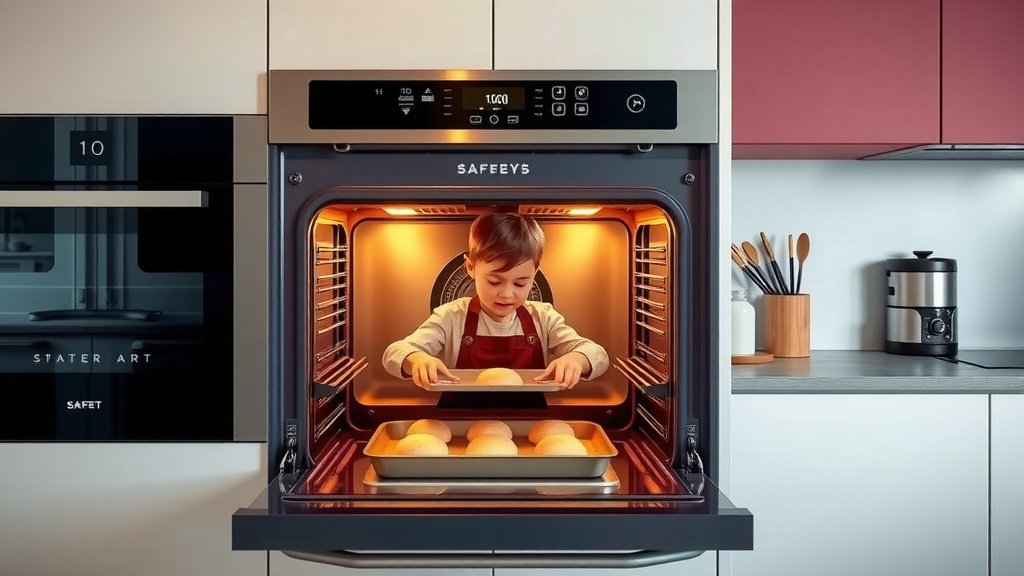
A good oven for cooking with children typically features cool-touch doors, child locks, and stable, pull-out racks designed for safety.
The safest oven prioritizes features that prevent burns and accidental operation, offering invaluable peace of mind for parents and caregivers.
- Cool-touch oven doors are essential to prevent accidental burns on little hands.
- Reliable child locks on controls stop curious children from turning on the oven.
- Stable, anti-tip racks make it safer to handle hot dishes, reducing spill risks.
- Electric ovens often pose fewer immediate risks than gas, as there’s no open flame.
- Considering an induction cooktop can significantly boost kitchen safety around kids.
What Is The Safest Oven For Cooking For Children?
The safest oven for cooking with children is one equipped with multiple layers of protection, focusing on preventing burns and accidental use.
This includes features like cool-touch doors and secure child locks, giving you confidence while your family is in the kitchen.
Why Oven Safety Matters So Much for Kids
Children are naturally curious, aren’t they? Their little hands want to touch everything, and the kitchen, with all its warm smells and interesting gadgets, is a big draw.
However, ovens get incredibly hot. A momentary lapse in attention can lead to a serious burn injury, which is something every parent wants to avoid.
We found that young children are particularly vulnerable to kitchen accidents (NIH), making oven safety a critical concern for any family.
The Hidden Dangers You Might Miss
It’s not just the oven door that poses a risk. Think about hot racks pulled out too far or accidental bumps against an oven door left ajar.
Small children might also try to climb on an open oven door, creating a tipping hazard for freestanding models.
Even control knobs can be tempting to twist and turn, potentially activating the oven without you realizing it.
Top Safety Features to Look For in an Oven
When you’re searching for a new oven, or just assessing your current one, certain features stand out as highly beneficial for child safety.
Prioritizing these can make a big difference in creating a safer cooking environment for your family.
Cool-Touch Oven Doors: A Must-Have
This is arguably the most important feature. Ovens with multiple layers of glass insulation keep the outer door surface relatively cool, even when the oven is scorching hot inside.
Many experts say that a truly cool-touch door can prevent painful contact burns on curious fingers, a common type of kitchen injury.
Always ask about the door’s temperature rating when comparing models; a door that stays below 120°F (49°C) is ideal (CPSC).
Reliable Child Locks and Control Panels
Modern ovens often come with digital child lock features that disable the control panel, preventing accidental activation or temperature changes.
Some models even have physical covers or push-and-turn knobs that are harder for small children to manipulate, offering an added layer of security.
It’s worth checking how intuitive and secure these locking mechanisms are during your shopping process.
Stable Racks and Anti-Tip Brackets
Smooth-gliding oven racks that lock into place can reduce the risk of accidentally pulling a hot dish too far out.
For freestanding ovens, ensure it comes with and you install an anti-tip bracket, which anchors the oven to the wall.
Research has shown that anti-tip brackets are vital for preventing serious accidents, especially if a child opens a heavy oven door and climbs on it (Consumer Reports).
Integrated Exhaust Systems for Air Quality
While not directly preventing burns, a good range hood or integrated exhaust system is crucial, particularly if you have a gas oven.
Proper ventilation removes cooking fumes and any potential carbon monoxide, contributing to overall kitchen air quality and safety.
We found that effective ventilation is a key part of maintaining a healthy home environment (EPA).
Types of Ovens and Their Safety Aspects
The kind of oven you have can also play a role in its inherent safety features. Let’s compare a few common types.
| Oven Type | Pros for Child Safety | Cons for Child Safety |
|---|---|---|
| Electric Oven | No open flame, often more precise temperature control. | Heating elements still get very hot; exterior can be hot. |
| Gas Oven | Often preferred for certain cooking styles. | Open flame risk, requires good ventilation for gas byproducts. |
| Convection Oven | Cooks faster (less time near hot oven), distributes heat evenly. | Still reaches high temperatures, door can be hot without cool-touch feature. |
| Induction Cooktop | Only heats the pan, surface stays cool; instant heat control. | Initial cost can be higher; only the cooktop, not the oven part. |
Electric Ovens: Generally Safer?
Electric ovens often don’t have an open flame, which many parents find comforting. There’s no gas line or ignition to worry about.
However, the electric heating elements still glow red hot and the oven exterior can become very warm without cool-touch technology.
Always remember that while electric might seem safer, burn risks remain present.
Gas Ovens: What You Need to Know
Gas ovens use a flame to heat, which introduces a different set of considerations.
The primary concern is ensuring proper ventilation to dissipate any potential gas leaks or carbon monoxide, though modern ovens have many safety cut-offs.
Regular maintenance and ensuring flame ignition is working correctly are important for these models.
Convection Ovens: A Quick Look
Convection refers to a fan that circulates hot air, making food cook more evenly and often faster.
Faster cooking means less overall time the oven is on, but it doesn’t inherently make the oven’s external temperature safer unless it also has cool-touch technology.
It’s a cooking feature, not primarily a safety feature, so evaluate it based on other safety attributes.
Considering Induction Cooktops
While not an oven itself, many ranges combine an oven with a cooktop, and induction cooktops are a game-changer for child safety.
We found that induction technology heats cookware directly using electromagnetic fields, leaving the cooktop surface itself relatively cool to the touch (DOE).
This means no hot burners, greatly reducing the risk of accidental burns when cooking on the stovetop.
- Only the cookware gets hot, not the surface.
- Heat is generated instantly and stops instantly when removed.
- No open flame or glowing electric elements.
- Often includes automatic pan detection, turning off if no pan is present.
Beyond Features: Safe Oven Habits for Families
Even the safest oven still requires vigilant habits and a well-organized kitchen to keep children truly safe.
Technology helps, but your daily routines make the biggest difference in preventing accidents.
Setting Up Your Kitchen for Success
Think about how you use your kitchen. Can you make small changes that add up to big safety improvements?
Consider these points to create a child-friendly cooking space:
- Keep oven mitts and pot holders easily accessible.
- Always place pots and pans on back burners.
- Avoid using the oven door as a step stool or a place to rest heavy items.
- Keep flammable materials, like dish towels, away from hot surfaces.
- Ensure your smoke and carbon monoxide detectors are working.
Teaching Children About Kitchen Safety
Age-appropriate education is a powerful tool. Start early by teaching your children about kitchen boundaries.
Explain that the oven is hot and not a toy, using simple, clear language they can understand, like “Oven is hot, don’t touch.”
As they grow, involve them in simple, safe kitchen tasks to foster respect for kitchen tools and appliances.
Conclusion
Choosing the safest oven for your family involves looking for a combination of smart design and reliable safety features. Prioritize cool-touch doors, robust child locks, and stable racking systems.
Remember, no oven is entirely “childproof,” but by combining these features with consistent supervision and smart kitchen habits, you can create a much safer environment for your children to grow and learn.
Your peace of mind in the kitchen is worth the careful consideration of these protective elements.
How often should I check my oven’s child lock?
It’s a good idea to test your oven’s child lock feature regularly, perhaps once a month or whenever you do a kitchen safety check. This ensures it’s still functioning correctly and gives you confidence in its protection.
Can I add safety features to an older oven?
You can add some external safety features to an older oven. These include knob covers, oven door latches, and an anti-tip bracket. However, you cannot add internal features like cool-touch doors or integrated digital child locks to an existing model.
What temperature is safe for a child to be near an oven?
There’s no specific “safe” temperature for a child to be near an oven, as proximity is key. The best rule is to teach children to keep a safe distance from a hot oven at all times. A cool-touch door helps, but direct contact should still be avoided.
Are built-in ovens safer than freestanding ones?
Built-in ovens are generally considered slightly safer because they are securely installed within cabinetry, making them less prone to tipping than freestanding models. However, they still require cool-touch doors and child locks for optimal safety.
What if my child accidentally turns on the oven?
If your child accidentally turns on the oven, remain calm. Immediately turn off the oven and engage any child lock features. Check the oven for any items that might have been left inside. This situation highlights the critical need for child locks and supervision.
