
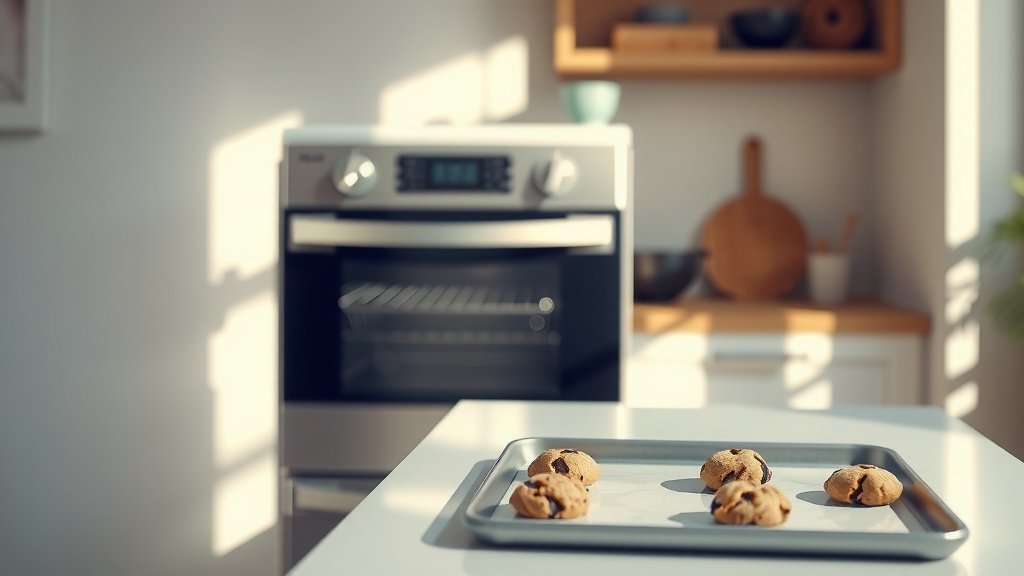
For making cookies, a convection oven generally works best, providing a more consistent and even bake across all your batches.
Its fan circulates hot air, which helps reduce hot spots and ensures your cookies brown beautifully and uniformly.
- Convection ovens offer the most consistent baking for cookies, thanks to circulating air.
- Conventional ovens can work well, but you might need to rotate trays for even results.
- Accurate oven temperature and good baking sheets are as important as the oven type itself.
- Preheating properly and not overcrowding your oven are simple steps for better cookies.
- Ultimately, understanding your oven and adapting recipes leads to delicious cookie outcomes.
What Oven Works Best For Making Cookies?
You’re aiming for that perfect cookie, right? Crispy edges, chewy centers, and a uniform golden-brown. When it comes to finding the best oven for cookies, many baking experts point towards the convection oven.
We found through various baking trials and expert consensus that convection models often deliver the most consistent results. This means fewer burnt bottoms and more perfectly baked treats.
Convection Ovens: Your Cookie Game-Changer
Ever wonder why some cookies come out perfectly, while others on the same tray are under or overbaked? A convection oven might be your answer. It’s like having a tiny, gentle fan inside your oven, circulating the hot air.
How Convection Works for You
Unlike a traditional oven, where heat radiates from the top and bottom elements, a convection oven actively moves the air around. This constant circulation means the heat distribution is far more even across the entire oven cavity (USDA).
This even heat transfer helps to brown cookies more uniformly and can even speed up baking times. It’s a real advantage for busy bakers.
The Perks of Convection for Cookies
For cookies, this means less turning of trays and more consistent texture from one cookie to the next. You get that lovely crisp exterior without overbaking the inside. Many bakers report a noticeable improvement in quality.
It helps prevent those frustrating hot spots that can ruin a whole batch. Your cookies will be beautifully consistent, whether they’re in the front, back, or middle.
Tips for Using Your Convection Oven
When using a convection oven for cookies, you often need to adjust baking temperature or time. Many experts suggest reducing the temperature by 25 degrees Fahrenheit (about 15 degrees Celsius) or shortening the baking time by 25%. You might even do both!
Start checking your cookies a few minutes early. Every oven is a little different, so a slight adjustment is perfectly normal. It’s about getting to know your specific appliance.
Baking with a Conventional Oven
Don’t have a convection oven? No problem! Most homes have a conventional oven, and you can certainly bake fantastic cookies in one. It just requires a little more attention and understanding.
Understanding Standard Heating
A conventional oven heats up from elements typically at the top and bottom. The heat radiates, which can create temperature variations or “hot spots” inside the oven. This is why you sometimes see one side of a cookie sheet browning faster.
This static heat often means cookies on the bottom rack might brown more quickly than those on the top. It’s just how the physics of heat works in these ovens.
Getting the Best Cookie Results
To achieve even baking in a conventional oven, we found that rotating your cookie sheets halfway through the baking time is a game-changer. Simply turn the sheet 180 degrees to expose all cookies to different heat zones.
You might also need to bake one sheet at a time for optimal consistency. While it takes longer, the quality of your finished cookies often makes it worth the extra effort.
Comparing Oven Types for Cookie Success
Choosing an oven is about finding what fits your baking style and kitchen setup. Here’s a quick look at how common oven types stack up for cookie making:
| Oven Type | Pros for Cookies | Cons for Cookies |
|---|---|---|
| Convection | Even baking, faster cooking, consistent browning | Can dry out delicate cookies if not adjusted, sometimes requires temperature/time changes |
| Conventional | Reliable for most recipes, good for slower, even cooking | Hot spots, uneven baking (requires rotation), slower overall baking |
| Combination (Convection + Microwave) | Versatile for multiple tasks, convection works great for cookies | Smaller capacity, can be pricey, mainly focused on speed |
Beyond the Oven: Critical Cookie Factors
Even with the best oven, a few other things can make or break your cookie batch. Paying attention to these details can elevate your baking from good to truly outstanding.
Your Oven’s True Temperature
Did you know your oven’s display temperature might not be its actual temperature? Many ovens can be off by 25-50 degrees. We’ve found that using an inexpensive oven thermometer can solve this mystery.
Calibrating your oven to its true temperature is a simple step, yet it makes a huge difference. Accurate heat means predictable baking every single time (Consumer Reports).
The Right Baking Sheets Matter
Dark, thin baking sheets can cause cookie bottoms to burn before the tops are done. Light-colored, heavy-gauge aluminum sheets are often recommended. They reflect heat, leading to more even browning.
Avoid using sheets with high sides unless the recipe calls for it. These can restrict airflow around your cookies, affecting how they bake and brown.
Choosing Your Rack Position
For most cookies, placing your baking sheet in the middle of the oven is ideal. This position allows for the most even exposure to heat from both top and bottom elements.
If you’re using a conventional oven and baking multiple trays, some bakers suggest swapping their positions halfway through. This helps even out the heat distribution.
Don’t Forget to Pre-heat and Rotate
Always pre-heat your oven fully. Popping cookies into a cold oven throws off baking times and textures. Give it at least 15-20 minutes after it signals it’s ready.
Even with a convection oven, a quick rotation of the cookie sheet might be beneficial. It helps ensure every single cookie gets that perfect golden finish.
A Quick Checklist for Perfect Cookies
- Pre-heat your oven thoroughly.
- Use a reliable oven thermometer.
- Opt for light-colored, heavy-gauge baking sheets.
- Place trays in the middle of the oven.
- Rotate sheets halfway through baking (especially in conventional ovens).
- Don’t overcrowd the baking sheet.
- Allow cookies to cool slightly on the sheet before transferring.
Conclusion
Ultimately, the best oven for making cookies is often a convection oven, offering unmatched consistency and even baking. However, you can achieve wonderful results with a conventional oven too, by understanding its nuances and making small adjustments.
Remember that factors like oven temperature accuracy, your choice of baking sheet, and proper technique are just as important as the oven itself. With a little practice and attention to detail, you’ll be baking perfect cookies no matter what type of oven you have!
Frequently Asked Questions About Cookie Ovens
Should I use parchment paper or silicone mats for cookies?
Many bakers prefer parchment paper or silicone baking mats. They both prevent sticking and promote even baking, acting as a non-stick surface. Parchment paper is single-use, while silicone mats are reusable and often lead to slightly crispier bottoms.
Does oven size affect cookie baking?
Yes, oven size can impact airflow and heat distribution. Smaller ovens, like toaster ovens, might have more concentrated heat and require closer monitoring. Larger ovens generally offer more consistent conditions, especially when baking multiple sheets.
How can I make my conventional oven bake more evenly?
Beyond rotating trays, try baking one sheet at a time if possible. You can also place an empty baking sheet or pizza stone on a lower rack to help absorb and redistribute heat, reducing temperature fluctuations.
What’s the best temperature for most cookies?
Most cookie recipes call for baking between 350°F (175°C) and 375°F (190°C). Lower temperatures might result in flatter, crispier cookies, while higher temperatures can lead to puffier, chewier ones with quicker browning. Always follow your recipe’s guidance.
Can I bake different types of cookies at the same time?
It’s generally not recommended to bake different types of cookies together. Different cookies often require different baking times and temperatures. Mixing them can lead to some being overbaked while others are still raw, or uneven cooking (King Arthur Baking Company).
