
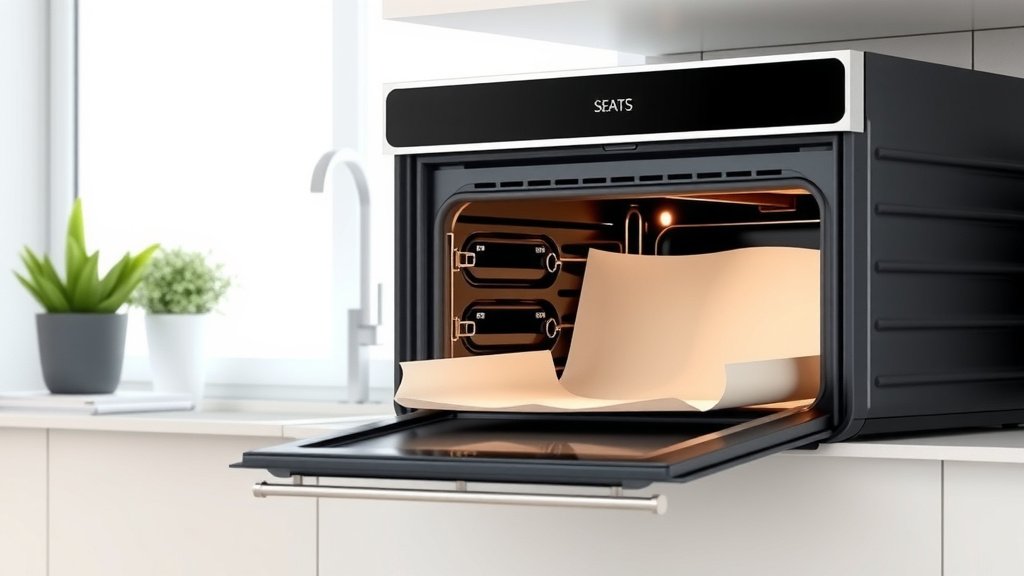
Yes, you can generally use parchment paper in a countertop oven, but it’s vital to check its temperature rating and ensure it doesn’t touch the heating elements.
Always consider your oven’s size and heat distribution when using parchment paper in countertop ovens to avoid safety issues.
Here’s a quick summary of what you need to know:
- Always confirm your parchment paper’s maximum temperature limit.
- Keep the paper away from the hot heating elements inside your oven.
- Parchment paper makes cleanup much easier and prevents food from sticking.
- Avoid using parchment paper under the broiler setting in any oven.
- Choose unbleached parchment paper for a more natural option if you prefer.
Can You Use Parchment Paper In Countertop Oven?
Yes, using parchment paper in your countertop oven is generally safe and helpful, as long as you adhere to crucial safety guidelines.
Always keep it away from heating elements and ensure the temperature does not exceed the paper’s rating.
Why Bother with Parchment Paper?
Are you tired of food sticking to your baking sheets? Parchment paper is a kitchen superhero for that!
It creates a non-stick surface, making cleanup a breeze. We found that most home cooks appreciate less scrubbing after meals.
The Cleanup Advantage
Think of parchment paper as a disposable liner for your baking pans. It catches drips and crumbs, saving you time.
When you’re done, you simply lift the paper and toss it. It’s a real time-saver in the kitchen.
Perfect for Delicate Foods
Cookies, roasted vegetables, or delicate fish benefit greatly from parchment. They won’t stick or break apart.
This means your food comes out looking picture-perfect every time. Many experts say it improves food presentation.
Checking the Temperature Limits
Every roll of parchment paper has a temperature limit, usually printed on the box. This is your first safety check.
Most brands can withstand temperatures up to 400°F or 425°F (about 204°C or 218°C).
Understanding Your Oven’s Heat
Countertop ovens can sometimes run hotter than their dial suggests, or have hot spots. This is common with smaller appliances.
Always compare your oven’s set temperature with the parchment paper’s limit before you start baking.
The Golden Rule: Avoid Heating Elements
This is arguably the most important safety tip. Parchment paper can ignite if it touches the exposed heating coils.
Whether your oven has coils on top, bottom, or both, make sure the paper stays well clear.
Proper Sizing and Placement
Cut your parchment paper to fit your baking pan perfectly. Don’t let it hang over the edges.
Excess paper can flap up and touch the elements, causing a fire hazard. We found that exact sizing prevents accidents.
When NOT to Use Parchment Paper
While parchment paper is versatile, it’s not suitable for every cooking method or temperature.
Knowing its limitations keeps you and your kitchen safe.
- Broiling: Never use parchment paper under the broiler. Broil settings use very high, direct heat, which will likely cause the paper to catch fire.
- Very High Temperatures: If a recipe calls for temperatures above your paper’s limit, choose another option like foil or a silicone mat.
- Direct Flame: Avoid any direct contact with open flames or grill elements.
Types of Parchment Paper
Did you know there are a few options? Understanding them helps you make a better choice for your kitchen needs.
Most common types are bleached and unbleached, with slightly different properties.
Bleached vs. Unbleached
Bleached parchment paper is white; it’s treated with chlorine during processing. Unbleached is brown and is processed without chlorine.
Functionally, they perform similarly, but some prefer unbleached for environmental reasons (Many experts suggest).
Alternatives to Parchment Paper
What if you don’t have parchment paper, or your recipe’s temperature is too high?
Luckily, you have a few good choices that work well in countertop ovens.
| Alternative | Best Use | Consideration |
|---|---|---|
| Aluminum Foil | High-heat roasting, sealing moisture | Food can stick, not ideal for delicate baking. |
| Silicone Baking Mats | Reusable, non-stick, high-heat tolerance | Can be expensive upfront, needs washing. |
| Greased Pan | Standard baking, cookies, cakes | Less non-stick than parchment, more cleanup. |
Maximizing Airflow in Countertop Ovens
Countertop ovens are compact, meaning airflow can be a bit tighter. Parchment paper can affect this.
Don’t completely cover your food item or the pan’s surface, especially in convection models.
Why Airflow Matters
Good airflow ensures even cooking and browning. If you block too much air, parts of your food might not cook properly.
Always leave some space around your food for heat to circulate. Research often connects proper airflow with even cooking (USDA guidelines).
A Quick Checklist for Safe Use
Before you slide that pan into your countertop oven, run through this mental checklist.
It helps ensure a safe and successful cooking experience every time.
- Is the parchment paper’s temperature limit higher than your oven’s setting?
- Is the paper trimmed so it won’t touch heating elements or oven walls?
- Are you avoiding the broiler setting?
- Is there enough space for air to circulate around your food?
- Is the paper flat and not crumpled up too much?
Keeping Your Oven Clean
Regular cleaning of your countertop oven is important, whether you use parchment paper or not.
Crumbs and grease buildup can create fire hazards over time, as many appliance manufacturers warn.
Conclusion
Using parchment paper in your countertop oven is a fantastic way to simplify cleanup and improve your cooking results, especially for delicate items.
Just remember those critical safety steps: always check the temperature rating and, most importantly, keep the paper away from those hot heating elements.
With a little care and attention, your countertop oven and parchment paper can be a powerful, convenient duo in your kitchen!
Can I use parchment paper in a toaster oven?
Yes, you can generally use parchment paper in a toaster oven. The same rules apply: ensure the paper’s temperature limit isn’t exceeded, and critically, trim it so it doesn’t touch the heating elements, which are often very close to the rack in toaster ovens.
What happens if parchment paper touches the heating element?
If parchment paper touches a heating element, it can scorch, smoke, or even catch fire. Heating elements get extremely hot, well beyond the paper’s heat tolerance, leading to a dangerous situation. Always keep a close eye on your oven if this happens.
Is parchment paper toxic when heated?
Parchment paper is designed to be heat-resistant and non-toxic for cooking at its specified temperature limits. It’s typically coated with silicone, which is food-safe. If used correctly, it won’t leach harmful chemicals into your food (Many food safety organizations confirm).
Can I reuse parchment paper?
It depends. For light uses like baking cookies or warming pastries, you might be able to reuse a piece of parchment paper once or twice. However, if it’s greasy, stained, or has become brittle from heat, it’s best to discard it. Reuse only if it’s still clean and structurally sound.
How do I prevent parchment paper from curling in the oven?
To prevent parchment paper from curling, crumple it up into a ball first, then flatten it out before placing it in the pan. This breaks down the paper’s memory and helps it lay flatter. You can also lightly grease the pan underneath to help it stick.
