
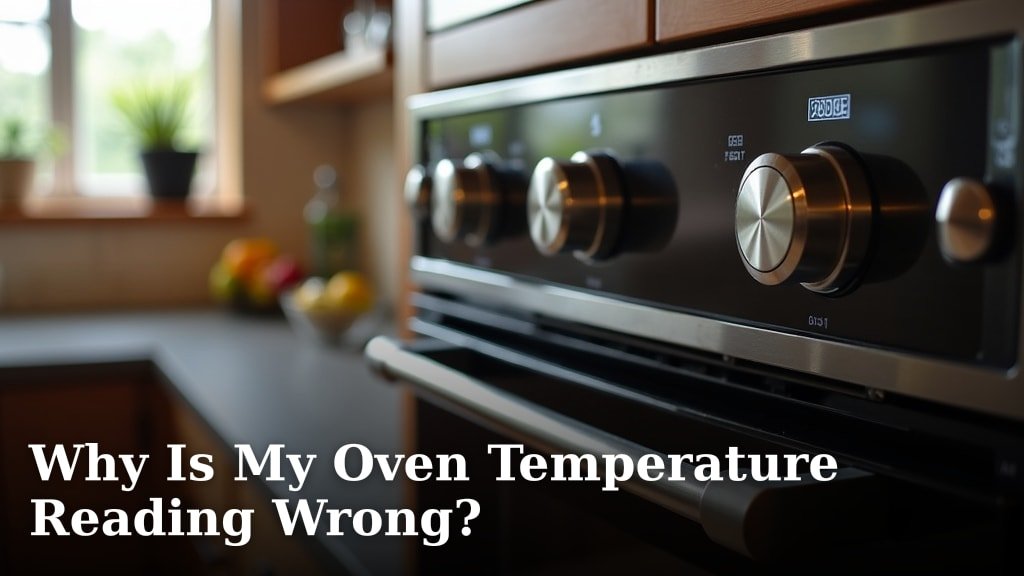
Your oven temperature might be reading wrong primarily due to a faulty thermostat or a miscalibrated sensor. These issues can cause your oven to heat inconsistently, leading to cooking frustrations.
We found that many common oven problems stem from these components. Whether your brownies are burnt or your roast is undercooked, an inaccurate oven temperature can throw off your recipes. It’s a common issue that many home cooks face.
- Faulty thermostat causes temperature inaccuracies.
- Miscalibrated sensor leads to inconsistent heating.
- Oven temperature issues impact cooking results.
- Regular calibration can prevent problems.
Let’s walk through exactly why your oven might be displaying the wrong temperature and what you can do about it. You deserve perfectly cooked meals every time!
Understanding Inaccurate Oven Temperature Readings
An inaccurate oven temperature can really mess up your cooking. You might wonder, “Why is my oven doing this?” We found several common culprits that can throw off your oven’s performance.
Most often, issues trace back to the oven’s core heating and sensing mechanisms. Understanding these parts helps you pinpoint the problem.
Common Reasons Your Oven Temperature is Off
There are a few key components that work together to maintain your oven’s temperature. When one of these falters, your oven can’t heat correctly or read temperatures accurately.
Think of it like a conductor leading an orchestra; if the conductor is off, the music won’t sound right. Your oven has its own “conductors.”
The Thermostat: Your Oven’s Brain
The thermostat is essentially your oven’s brain. It tells the heating elements when to turn on and off. If it’s faulty, it sends incorrect signals.
A bad thermostat might tell your oven it’s reached 350°F when it’s only 300°F. This leads to undercooked food, no matter what the display says.
Temperature Sensor: The Oven’s Eyes and Ears
Your oven’s temperature sensor is like its eyes and ears, constantly monitoring the internal heat. It sends this information back to the control board.
If the sensor is damaged, dirty, or miscalibrated, it can send wrong readings. This makes your oven either overheat or underheat, leading to inconsistent results.
Heating Elements: The Oven’s Muscles
Ovens have two main heating elements: a bake element (usually at the bottom) and a broil element (at the top). These are what generate the heat.
If one of these elements is partially failing or cycling incorrectly, it can cause uneven heating. Your oven might reach the target temperature, but pockets of cold spots remain.
Environmental Factors Affecting Oven Temperature
It’s not always a broken part. Sometimes, things around your oven or even your habits can make the temperature seem off.
You might be surprised by how much small external factors can influence internal oven readings.
Oven Door Seal: The Barrier to Heat Loss
The rubber or silicone gasket around your oven door creates a seal. This seal keeps the hot air inside your oven where it belongs.
If the door seal is worn, cracked, or loose, heat escapes. Your oven will then struggle to maintain a consistent temperature, often running colder than set.
You can often feel warm air escaping when your oven is on, a clear sign of a failing seal.
Dirty Oven Interior: Insulation Troubles
We found that a very dirty oven can actually impact temperature. Built-up grease and food debris can act as insulation, but not in a good way.
This debris can prevent heat from distributing evenly. It can also interfere with the sensor’s ability to get an accurate reading, as it might read the cooler surface of the grime instead of the air temperature.
Oven Location and Ventilation
Believe it or not, where your oven sits in your kitchen can matter. If it’s too close to a cold draft or an external wall, it might have to work harder to maintain heat.
Proper ventilation is also important. Ensure your oven isn’t overheating its surroundings, which can sometimes throw off its own internal calibration.
How to Test Your Oven’s Accuracy
Before calling a technician, you can perform a simple test to see if your oven is truly off. You’ll need an external oven thermometer for this.
This is often the first step we recommend. It helps you get a real sense of what’s happening inside your oven.
Using an Independent Oven Thermometer
An independent oven thermometer is your best friend here. Don’t rely solely on your oven’s built-in display.
Place a good quality, oven-safe thermometer in the center of your oven. Preheat your oven to a specific temperature, say 350°F (175°C).
After it preheats and runs for at least 20 minutes, check the thermometer. Does it match your oven’s display?
We recommend checking it multiple times over an hour. An oven’s temperature naturally fluctuates, but it shouldn’t be wildly off.
| Symptom | Possible Cause | Action You Can Take |
|---|---|---|
| Food consistently undercooked | Oven running cold (thermostat/sensor) | Test with independent thermometer; consider calibration or repair |
| Food consistently burnt | Oven running hot (thermostat/sensor) | Test with independent thermometer; consider calibration or repair |
| Unevenly cooked food | Failing heating element, poor door seal, dirty oven | Inspect elements/seal; clean oven thoroughly |
| Long preheat times | Failing heating element, poor insulation | Check elements; inspect door seal |
What You Can Do About It: Troubleshooting Steps
So, you’ve confirmed your oven is acting up. What’s next? Here are some steps you can take yourself before needing a professional.
Taking these actions can often resolve simpler issues and save you a service call.
Checking the Temperature Sensor
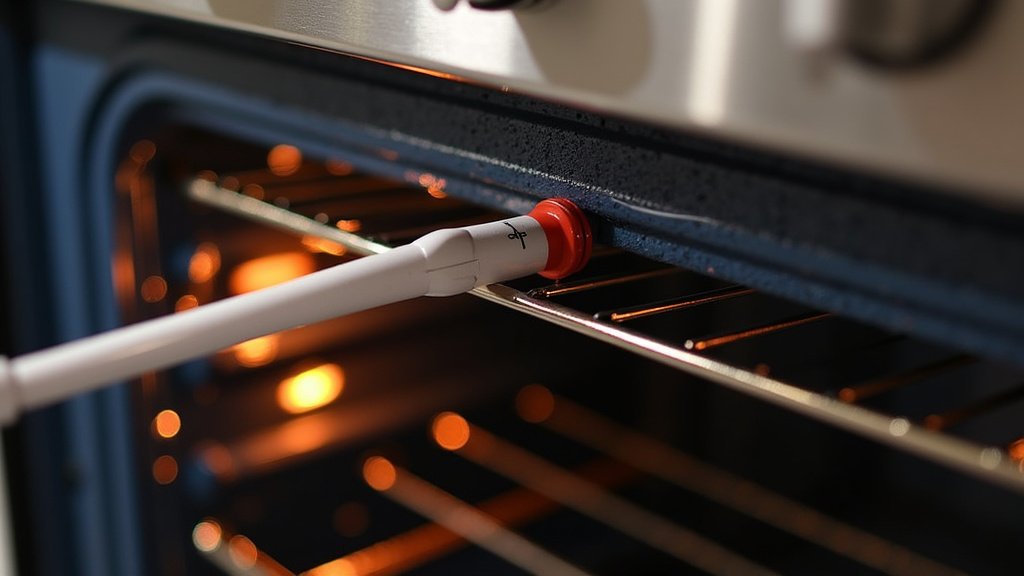
Locate your oven’s temperature sensor. It’s usually a small, metal probe sticking out from the back or side wall inside the oven.
Ensure it’s clean and not touching the oven wall or racks. Sometimes, simply repositioning it can help. If it looks damaged or corroded, it might need replacement (National Institutes of Health).
Oven Calibration: A Simple Adjustment
Many modern ovens allow for a manual temperature calibration. This lets you adjust the oven’s temperature display to match what a reliable thermometer says.
Check your oven’s user manual for specific instructions. It usually involves going into a settings menu and adjusting the temperature offset up or down by a few degrees.
Inspecting the Door Seal
Take a good look at your oven door gasket. Is it brittle? Cracked? Does it hang loosely?
A simple “dollar bill test” can help: Close the oven door on a dollar bill. If you can pull the bill out easily, the seal is weak in that spot. Replace a faulty seal to keep heat in.
When to Call a Professional
Sometimes, DIY fixes aren’t enough. If you’ve tried the troubleshooting steps and your oven is still giving you trouble, it’s time for an expert.
Don’t hesitate to call a qualified appliance technician. They have the tools and experience to diagnose and fix more complex issues.
Safety First: Electrical and Gas Ovens
Remember that ovens involve high voltage electricity or gas. If you’re uncomfortable with any repair, or if it involves disconnecting major components, always call a professional.
Your safety is paramount. Never attempt repairs that are beyond your skill level (Consumer Product Safety Commission).
Checklist for a Misbehaving Oven
- Test with an independent oven thermometer.
- Clean the oven thoroughly.
- Inspect the oven door seal for damage.
- Locate and check the temperature sensor.
- Consult your oven manual for calibration instructions.
- Consider calling a professional for persistent issues.
By following these steps, you can get a clearer picture of why your oven temperature might be off. With a little detective work, you can get back to baking and roasting with confidence.
Conclusion
An inaccurate oven temperature can be a real kitchen puzzle, leading to frustrating cooking results. We’ve walked through the common culprits, from a faulty thermostat or sensor to simple issues like a worn door seal or a dirty oven. By understanding these potential problems and how to test for them, you’re already halfway to a solution.
Remember, a reliable external oven thermometer is your first step to diagnosis. Don’t hesitate to check your oven’s manual for calibration tips. If these straightforward troubleshooting steps don’t fix the issue, calling a qualified professional is always the safest and most effective next step to get your oven back in perfect working order.
Frequently Asked Questions
Why is my new oven’s temperature off?
Even new ovens can have slight calibration issues from the factory, or their sensors might need to “settle in.” It’s a good idea to perform the oven thermometer test to confirm accuracy. If it’s significantly off, you can often calibrate it yourself or contact the manufacturer for warranty service.
Can a dirty oven really affect temperature?
Yes, a very dirty oven can indeed impact temperature distribution and accuracy. Built-up grease and food debris can act as uneven insulation. This can cause hot or cold spots, and it might interfere with the temperature sensor’s ability to get an accurate reading of the air temperature.
How often should I calibrate my oven?
Most ovens don’t need frequent calibration. However, if you notice your cooking results are consistently off, or if you’ve recently moved the oven, it’s a good time to check its accuracy with an external thermometer. Calibrate it as needed, perhaps once every year or two if you’re a frequent baker.
Is it safe to use an oven that’s reading the wrong temperature?
While an oven with an inaccurate temperature reading might still function, it can lead to undercooked food (a food safety risk) or burnt food. For gas ovens, significant temperature fluctuations can sometimes indicate a problem with the gas flow or ignition, which could be a safety concern. It’s best to address the issue promptly.
Can oven temperature vary during cooking?
Yes, oven temperatures naturally fluctuate. When your oven reaches the set temperature, the heating elements cycle on and off to maintain it, causing slight variations. A good oven will typically stay within 10-25 degrees Fahrenheit of your set temperature. Wild swings beyond that indicate a problem.
