
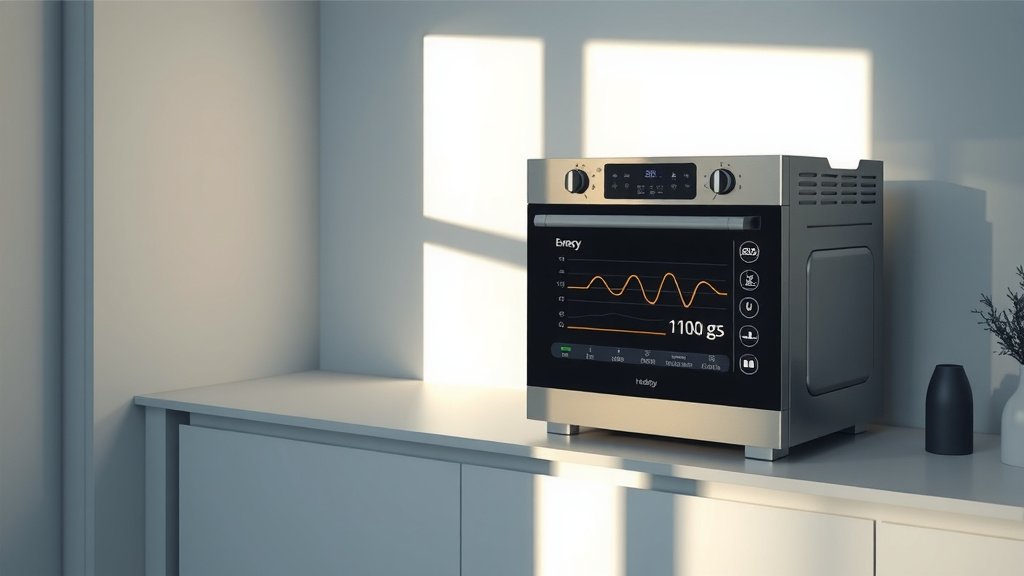
A countertop oven typically uses between 1200 and 1800 watts of electricity, translating to an average cost of 15 to 30 cents per hour during active cooking, depending on your local utility rates.
How much electricity a countertop oven uses can vary based on its wattage, cooking temperature, and the duration of use for each cooking session.
TL;DR
- Your countertop oven’s electricity use depends heavily on its wattage and how long it runs for.
- Most standard models draw between 1200 to 1800 watts, similar to a powerful hairdryer or toaster.
- For smaller meals or snacks, a countertop oven is often a more energy-efficient choice than a full-sized oven.
- Expect the operating cost to be roughly 15-30 cents per hour of active cooking time.
- Simple habits, like choosing the right size and avoiding excessive preheating, can significantly reduce your energy bill.
How Much Electricity Does A Countertop Oven Use?
Generally, a countertop oven will use between 1200 and 1800 watts, making it a fairly efficient appliance for many kitchen tasks.
Thinking about adding a countertop oven to your kitchen? Perhaps you already have one and are just curious about its energy consumption. It’s a great question, especially with today’s focus on saving energy and managing household expenses. Let’s break down the energy use of these handy kitchen helpers.
Understanding the Basics: Watts and Your Wallet
When we talk about electricity use, we often hear the term “watts.” What exactly are watts? Think of watts as the engine size of your appliance. A higher wattage means more power, which can lead to faster cooking but also higher electricity consumption. For countertop ovens, the wattage usually falls into a predictable range.
We found that most models are rated between 1200 and 1800 watts. To put that in perspective, a standard hairdryer might use 1500 watts. So, your countertop oven is not much different than some other common household items you use every day. Your utility bill reflects kilowatt-hours (kWh) used. One kWh is 1000 watts running for one hour.
Factors Influencing Energy Consumption
It’s not just the wattage on the box that determines your energy bill. Several things influence how much electricity your countertop oven actually uses.
- Temperature Setting: Naturally, a higher cooking temperature demands more power. Roasting at 400°F uses more energy than simply warming something at 250°F.
- Cooking Duration: The longer your oven runs, the more electricity it consumes. A quick reheat is far less demanding than baking a full chicken.
- Oven Size and Insulation: A larger oven or one with poor insulation might need to work harder to maintain its temperature. Modern ovens often have better insulation, making them more efficient.
- Preheating Time: Just like a regular oven, countertop models need to preheat. The initial burst of energy to get to temperature is often the most significant part of the energy draw.
Countertop Oven vs. Full-Sized Oven: The Efficiency Debate
Is your countertop oven truly better than your big, built-in oven for energy? Many experts say yes, for smaller tasks. Why?
A countertop oven has a much smaller interior space to heat. This means it reaches the desired temperature faster and retains heat more efficiently compared to its larger counterpart. Think of it this way: heating a small bathroom is quicker and cheaper than heating your entire house. For cooking a frozen pizza, a few chicken breasts, or a batch of cookies, the countertop oven is usually the more economical choice.
Calculating Your Specific Costs
Want to get a clearer picture of your own costs? It’s pretty straightforward. You’ll need two pieces of information:
- Your oven’s wattage (check the label or manual).
- Your electricity rate (found on your utility bill, typically in cents per kWh).
Here’s a simple formula: (Wattage / 1000) x Hours Used x Cost per kWh = Total Cost. So, if your 1500-watt oven runs for 1 hour, and electricity costs 15 cents per kWh, that’s (1500/1000) x 1 x $0.15 = $0.225 or about 23 cents.
Example Electricity Costs for Countertop Ovens
Let’s look at some average scenarios to give you a clearer idea of the running costs. These are estimates, of course, as rates vary wildly by location (U.S. Energy Information Administration).
| Wattage (W) | Approximate kWh per Hour | Cost per Hour (at $0.15/kWh) | Cost per Hour (at $0.20/kWh) |
|---|---|---|---|
| 1200W | 1.2 kWh | $0.18 | $0.24 |
| 1500W | 1.5 kWh | $0.23 | $0.30 |
| 1800W | 1.8 kWh | $0.27 | $0.36 |
Tips for Saving Electricity with Your Countertop Oven
You can definitely make your countertop oven even more energy-smart! Small changes can add up to noticeable savings.
- Use the right size: Match the oven to your food. Don’t use a large oven for a small snack.
- Don’t peek: Every time you open the oven door, heat escapes, and more energy is needed to get back to temperature.
- Preheat wisely: Only preheat for as long as necessary. Some dishes don’t even need a fully preheated oven.
- Clean regularly: A clean oven, especially the heating elements and interior, can operate more efficiently.
- Defrost first: Cooking frozen foods straight from the freezer requires more energy and time.
- Unplug when not in use: While minimal, some appliances draw a tiny amount of “phantom” power even when off.
When to Choose Your Countertop Oven
Your countertop oven is a star player for many cooking situations. It’s ideal for heating up leftovers, baking a small batch of cookies, toasting bagels, or cooking single servings. Think of it as your kitchen’s efficient assistant for anything that doesn’t require the vast space of a full-sized oven. You’ll save both time and energy.
Common Misconceptions About Oven Energy Use
It’s easy to misunderstand how appliances use energy. One common thought is that the wattage rating is the *only* thing that matters. But as we discussed, how you *use* the oven is just as important. Another myth is that bigger ovens are always worse. Not true if you’re cooking a big holiday turkey! It’s all about matching the tool to the task.
Maintenance for Peak Efficiency
A well-maintained countertop oven runs better and uses less energy. We found that keeping your oven clean ensures heating elements work efficiently and heat distributes evenly. Also, check the door seal periodically. A good seal keeps heat inside where it belongs, preventing energy waste. A simple wipe-down after use can really help.
Conclusion
Countertop ovens are fantastic kitchen tools, offering convenience and often superior energy efficiency for smaller cooking tasks compared to a full-sized oven. While they do use electricity, typically between 1200 and 1800 watts, their operating cost is quite reasonable, often just pennies per use. By understanding the factors that influence energy consumption and adopting a few smart habits, you can enjoy all the benefits of your countertop oven without worrying about a huge surge in your electricity bill. So, go ahead and bake that small batch of muffins!
What is the average wattage of a countertop oven?
The average wattage for most countertop ovens typically falls in the range of 1200 to 1800 watts, making them powerful enough for various cooking needs.
Is a countertop oven more energy-efficient than a conventional oven?
Yes, for smaller meals or tasks, a countertop oven is generally more energy-efficient than a conventional oven because it has a smaller space to heat and reaches temperature faster.
Does preheating a countertop oven use a lot of electricity?
Preheating uses a significant amount of electricity because the oven must work hard to reach the set temperature quickly. Minimizing unnecessary preheating or using shorter preheat times can save energy.
Can a countertop oven save me money on my electric bill?
A countertop oven can certainly save you money on your electric bill if you use it instead of your larger conventional oven for smaller cooking jobs, reducing overall energy consumption.
How does the insulation of a countertop oven affect its electricity use?
Good insulation in a countertop oven helps it retain heat more effectively, meaning the heating elements don’t need to cycle on as often to maintain temperature, which reduces overall electricity use.
