
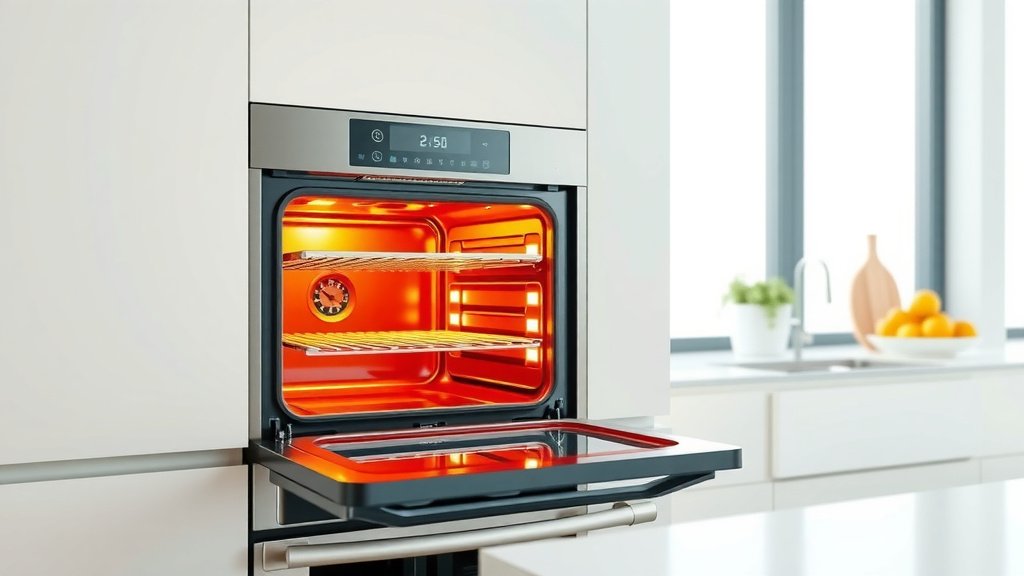
A double oven generally uses between 2,000 and 5,000 watts of electricity when actively heating, which translates to about 2.5 to 4.0 kilowatt-hours (kWh) per hour if both ovens are running at higher temperatures.
The total electricity usage of a double oven depends on factors like cooking temperature, duration, and whether you are using one or both cavities, making precise figures vary for each use.
- A double oven’s electricity use ranges from 2.5 to 4.0 kWh per hour when both parts are active.
- Preheating and self-cleaning cycles are the biggest energy users.
- Your local electricity rate determines the cost, often around $0.15-$0.25 per kWh.
- You can save energy by using convection, cooking in batches, and limiting door openings.
- Double ovens offer convenience, but they do have a higher potential for energy use than single ovens.
How Much Electricity Does A Double Oven Use?
Understanding how much electricity your double oven uses helps you manage utility bills and make smart choices. A double oven typically draws between 2,000 to 5,000 watts when its heating elements are working.
This power draw can be higher during initial preheating or intensive cooking. When both ovens are working, their combined consumption often sits between 2.5 to 4.0 kilowatt-hours (kWh) per hour (Energy Star).
Understanding Your Double Oven’s Power Needs
You have a double oven because it offers amazing flexibility, right? You can roast a turkey in one and bake a pie in the other. But this convenience comes with power requirements.
Knowing these needs helps you anticipate costs. It also guides you in making your cooking more energy-smart.
Watts, Kilowatts, and kWh Explained Simply
Let’s clear up some terms. A watt measures how much power an appliance uses at a moment. Imagine it like the speed of a car.
A kilowatt is 1,000 watts. Your electricity bill uses kilowatt-hours (kWh). This measures total energy used over time, like how far your car travels (Energy.gov).
One kWh is what a 1,000-watt appliance uses in one hour.
Average Wattage for a Double Oven
Double ovens vary, but most electric models have elements ranging from 2,000 to 5,000 watts. The lower oven might be slightly larger, but they operate similarly.
When you set your oven, the elements cycle on and off to maintain the temperature. They are not always at maximum power.
Does Preheating Use More Power?
Yes, absolutely. Preheating an oven demands a lot of electricity. Think of it like a car accelerating to highway speed.
The heating elements work at full power to reach your desired temperature quickly. This initial burst uses more energy than maintaining that heat (Department of Energy).
The Role of Self-Cleaning Cycles
The self-cleaning function is a powerhouse for electricity use. It heats the oven to extremely high temperatures, often over 900°F.
This process burns off food residue, which is super convenient. However, it can consume 6-10 kWh or more over a few hours (Appliance Magazine).
Calculating Your Double Oven’s Electricity Cost
Want to figure out your cooking costs? It is simpler than it sounds. You just need two things: your oven’s wattage and your electricity rate.
Your electricity rate is usually found on your utility bill, often expressed in dollars per kWh. For example, if your double oven uses 3 kWh in an hour and your rate is $0.15/kWh, it costs $0.45 for that hour of use.
| Oven Activity | Estimated Average Wattage | Approx. kWh per Hour |
|---|---|---|
| Preheating (each oven) | 3,000 – 5,000 W | 3.0 – 5.0 kWh (initial burst) |
| Baking (one oven) | 2,000 – 3,000 W | 1.5 – 2.5 kWh |
| Baking (both ovens) | 3,000 – 5,000 W | 2.5 – 4.0 kWh |
| Self-Cleaning Cycle | 3,000 – 6,000 W | Up to 10 kWh over multiple hours |
Example Scenario: Baking a Cake and Roasting Chicken
Imagine you are baking a cake at 350°F in one oven and roasting a chicken at 400°F in the other. Both ovens are on for about 1.5 hours.
Let’s say the combined power draw averages 3.5 kWh per hour. Over 1.5 hours, that’s 5.25 kWh. At $0.15/kWh, this meal costs about $0.79 in electricity. Not too bad for a delicious dinner!
Factors That Influence Double Oven Electricity Use
Many things play a role in how much power your double oven consumes. Thinking about these can help you manage your usage effectively:
- Cooking Temperature: Higher temperatures require more energy.
- Cooking Duration: Longer cooking times naturally use more electricity.
- Oven Insulation: Better-insulated ovens hold heat better and use less power.
- Frequency of Use: The more you use it, the more power it draws.
- Opening the Door: Each time you open the door, heat escapes, and the oven must work harder.
- Food Load: A full oven can be more efficient than a half-empty one, if cooking multiple items.
Are Double Ovens More Expensive to Run Than Single Ovens?
Potentially, yes, a double oven can be more expensive to run. It has two heating cavities instead of one. If you use both ovens often, your electricity consumption will be higher than if you just used a single oven.
However, if you only use one cavity at a time, its energy use is comparable to a single oven. The benefit lies in the flexibility, allowing you to cook more at once.
Smart Habits to Reduce Double Oven Electricity Consumption
You can definitely lower your double oven’s electricity use without sacrificing delicious meals. A few simple changes in your cooking routine can make a real difference.
Think about these easy tips to start saving energy:
- Preheat only when needed for certain foods, like baked goods.
- Use the right sized pan to improve heat distribution.
- Keep oven doors closed to hold heat inside and prevent energy loss.
- Cook multiple items together in both ovens when possible to maximize efficiency.
- Utilize residual heat by turning the oven off a few minutes early.
- Clean your oven regularly as grime can reduce efficiency.
Using Convection Settings Wisely
Many modern double ovens offer a convection setting. This circulates hot air, cooking food faster and more evenly.
Using convection can often allow you to lower the cooking temperature by about 25°F and reduce cooking time. This means less energy used overall, according to many oven manufacturers (GE Appliances).
Batch Cooking for Efficiency
Consider cooking several dishes at once. If you are going to heat up your double oven, why not make the most of it?
Bake a casserole in one oven and roast vegetables in the other. This way, you save on multiple preheating cycles later in the week.
Door Habits Matter
Every time you open the oven door, a significant amount of heat escapes. This forces the oven to work harder to bring the temperature back up.
Try to resist the urge to peek too often. Use the oven light or timer instead. This simple habit can noticeably reduce your double oven’s electricity use.
Conclusion
Your double oven is a powerful kitchen tool, offering amazing versatility for busy households. While it has the potential to use more electricity than a single oven, smart usage can keep those costs in check.
By understanding wattage, mindful preheating, and adopting simple habits like using convection or batch cooking, you can enjoy all the benefits without worrying about huge electricity bills. It’s about cooking smarter, not harder.
What is the average wattage of a typical electric double oven?
A typical electric double oven has heating elements that range from 2,000 to 5,000 watts. This wattage indicates its power draw when actively heating up or maintaining a temperature.
How much does it cost to run a double oven for an hour?
To estimate the cost, multiply the oven’s average kWh usage per hour (e.g., 2.5 kWh for one oven, 3.5 kWh for both) by your local electricity rate per kWh. For instance, 3.5 kWh at $0.15/kWh would cost $0.53 for one hour.
Does using both ovens in a double oven double the electricity usage?
No, using both ovens simultaneously does not exactly double the electricity usage. While it increases consumption compared to using just one oven, the second oven may not draw full power constantly, and the insulation helps retain heat, making the increase less than double.
Is a double oven more energy-efficient than using two separate single ovens?
Generally, a double oven integrated into one unit is often more energy-efficient than two completely separate single ovens. The shared insulation and integrated controls often result in less heat loss and more streamlined operation.
What is the biggest energy drain for a double oven?
The biggest energy drains for a double oven are typically the initial preheating phase, where elements draw maximum power to reach temperature, and the self-cleaning cycle, which heats the oven to extremely high temperatures over several hours.
