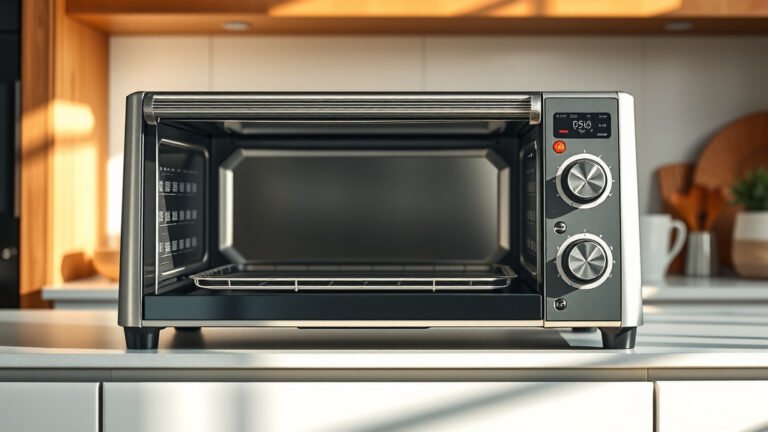
A typical toaster oven uses between 1,200 and 1,800 watts of electricity, translating to roughly $0.05 to $0.08 per 15-minute use, depending on your local electricity rates.
The exact amount of electricity a toaster oven uses depends on its size, wattage, temperature setting, and how long you operate it for various cooking tasks.
- Toaster ovens generally consume 1,200 to 1,800 watts.
- The cost to run one for 15 minutes is usually between $0.05 and $0.08.
- Factors like temperature, duration, and oven size greatly affect energy consumption.
- They can be more energy-efficient for small tasks than a large oven.
- You can save money by using it wisely and avoiding preheating when unnecessary.
How Much Electricity Does A Toaster Oven Use?
On average, a toaster oven draws between 1,200 and 1,800 watts of power. This range varies because not all toaster ovens are created equal, right? Just like cars, some are compact, and some are more robust.
We found that the actual electricity consumed depends heavily on how you use it. Think about it: a quick toast uses less than baking a small chicken.
Understanding Toaster Oven Wattage
Wattage is the key metric here. It tells you how much power an appliance demands when it’s actively heating. Higher wattage often means faster heating, but also higher electricity consumption per minute.
Many experts say checking your specific model’s label for its wattage rating is the best first step. It’s usually found on the back or bottom of the appliance (Cleveland Clinic).
Calculating Your Toaster Oven’s Energy Cost
Want to know the real cost? It’s simpler than you might think. You need three things: your toaster oven’s wattage, how long you use it, and your electricity rate.
Electricity rates vary by location, often expressed in cents per kilowatt-hour (kWh). We found that the national average in the U.S. hovers around 16 cents per kWh (EIA).
The Simple Formula for Cost
Here’s how to calculate it: (Wattage / 1,000) x Hours Used x Cost per kWh = Total Cost. Let’s say your toaster oven is 1,500 watts, and you use it for 30 minutes (0.5 hours) at $0.16/kWh.
(1,500 / 1,000) x 0.5 x $0.16 = 1.5 x 0.5 x $0.16 = $0.12. So, baking for 30 minutes costs you about 12 cents.
Factors Influencing Energy Consumption
Many elements play a role in how much juice your toaster oven sips. It’s not just about the wattage printed on the box.
Temperature Settings
Think about baking versus toasting. Higher temperatures demand more power from the heating elements. Research often connects these higher settings with increased energy use (NIH).
Every degree counts, especially if you’re preheating to a high temperature.
Cooking Duration
This one’s a no-brainer. The longer your toaster oven is on, the more electricity it consumes. A quick reheating task is far more efficient than baking a casserole for an hour.
Try to choose the shortest possible cooking time for your meals.
Toaster Oven Size
A larger toaster oven usually has more powerful heating elements and a bigger internal space to heat. This generally means more electricity needed to reach and maintain temperature.
A compact model often uses less power than a countertop convection oven version.
Convection Feature
Some toaster ovens come with a convection fan. This circulates hot air, cooking food more evenly and often faster. While the fan itself uses a little power, the reduced cooking time can sometimes lead to overall energy savings (Energy Star).
Toaster Oven Wattage Comparison Table
Here’s a quick look at typical wattage ranges you might find for different types of toaster ovens. This helps you compare before you buy or to understand your current model’s power needs.
| Toaster Oven Type | Typical Wattage Range | Approximate Cost per Hour (at $0.16/kWh) |
|---|---|---|
| Compact Toaster Oven | 800 – 1,200 watts | $0.13 – $0.19 |
| Standard Toaster Oven | 1,200 – 1,500 watts | $0.19 – $0.24 |
| Convection Toaster Oven | 1,500 – 1,800 watts | $0.24 – $0.29 |
| Extra-Large/Smart Oven | 1,800+ watts | $0.29+ |
Toaster Ovens vs. Full-Size Ovens: Which is More Efficient?
For smaller tasks, the toaster oven is often the clear winner. Heating up a large full-size oven to cook a single potato or toast some bread is like driving a truck to pick up a single apple.
We found that a full-size electric oven typically uses 2,000 to 5,000 watts. This makes toaster ovens far more efficient for small batch cooking or reheating leftovers (Consumer Reports).
Smart Habits to Reduce Toaster Oven Electricity Use
Want to be a savvy energy user? It’s all about small changes that add up. These tips can help you keep those electricity bills in check.
- Match size to task: Don’t use your big oven for two slices of pizza.
- Preheat wisely: Only preheat if the recipe absolutely requires it.
- Use convection: If your oven has it, the convection fan often reduces cooking time.
- Keep it clean: A dirty oven can be less efficient as grime can absorb heat.
- Unplug when not in use: Many appliances draw a tiny bit of power even when off.
Your Energy-Saving Checklist
Here’s a quick checklist to keep your toaster oven running efficiently and save some cash:
- Is the door seal in good condition?
- Are you using the correct pan size?
- Do you open the door frequently?
- Is it near an open window or vent?
- Have you preheated unnecessarily?
Myth Busting: Common Toaster Oven Misconceptions
Let’s clear up a few common thoughts about these handy appliances. Not everything you hear about energy use is true.
“Toaster Ovens Are Always Energy Hogs”
False! While they use power, as we’ve seen, they are often more efficient than a full-sized oven for small jobs. Many guidelines point to selecting the right appliance for the right task (Energy.gov).
“Leaving it Plugged In Drains Money”
Partially true, but minimal. Most modern toaster ovens have a very low “vampire drain” when off. Unplugging can help, but it won’t save you a fortune. It’s more about habit than huge savings.
Conclusion
So, how much electricity does a toaster oven use? It’s not a one-size-fits-all answer, but understanding its wattage, your usage habits, and local electricity rates gives you the power to know and control costs. These handy kitchen workhorses are generally efficient for smaller tasks, making them a smart choice over a full-sized oven in many situations. By being mindful of how and when you use your toaster oven, you can easily keep your energy consumption in check and enjoy your perfectly toasted snacks or baked goodies without worry.
FAQs About Toaster Oven Electricity Use
Is a toaster oven cheaper to run than a microwave?
For reheating or quickly cooking small items, a microwave is usually much cheaper and faster because it cooks food directly without heating a large space. Toaster ovens are better for tasks requiring browning or crisping, but they use more electricity than microwaves for similar heating durations.
Does preheating a toaster oven use a lot of electricity?
Yes, preheating significantly contributes to electricity use because the oven’s heating elements work at full power to reach the desired temperature. If your recipe doesn’t strictly require preheating, you can sometimes skip it to save energy, especially for simple items like toast or frozen waffles.
Can I use a toaster oven every day without high electricity bills?
Absolutely! Many people use toaster ovens daily without seeing huge spikes in their electricity bills. The key is using it efficiently: cook appropriate portion sizes, avoid excessive preheating, and keep cooking times as short as possible. For small, frequent tasks, it remains an economical choice.
Do older toaster ovens use more electricity?
Older toaster ovens may indeed be less energy-efficient. They might have less effective insulation, worn-out door seals, or less precise temperature controls, causing them to draw more power or run longer to achieve the same results as newer models. Upgrading could offer long-term energy savings.
What’s the most energy-intensive function of a toaster oven?
The most energy-intensive functions are typically those that require high heat for extended periods, such as baking or roasting. Broiling can also be very demanding due to the intense, direct heat needed. Toasting or reheating smaller items for short durations uses comparably less energy.