
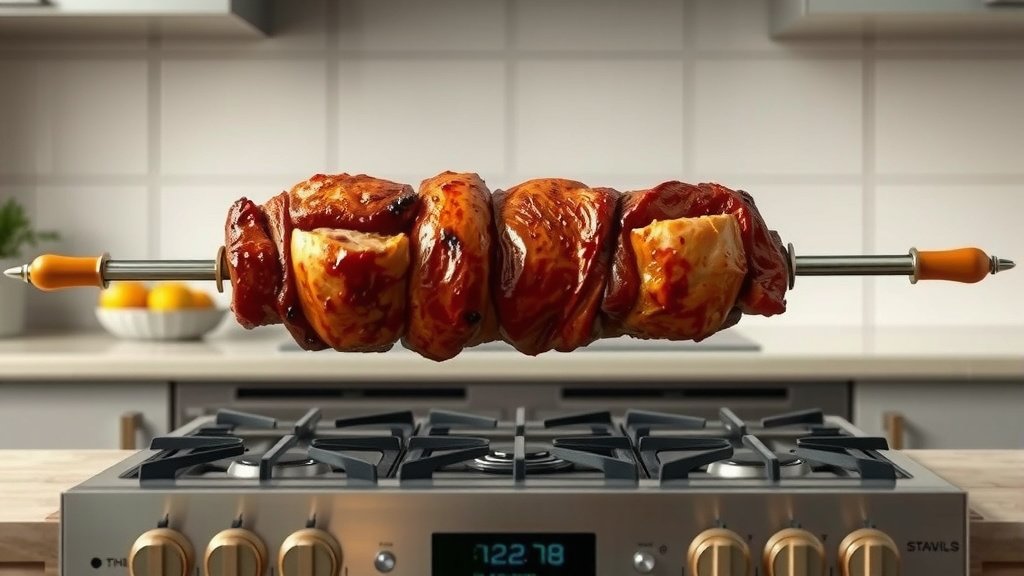
To balance meat on a rotisserie spit, you must position the meat symmetrically around the spit rod, ensuring its weight is evenly distributed.
This prevents wobbling, uneven cooking, and unnecessary strain on your rotisserie motor, leading to perfectly cooked, tender results.
Here’s a quick rundown of how to master rotisserie balance:
- Choose the right meat size and shape for your rotisserie.
- Truss or tie your meat tightly to maintain its shape during rotation.
- Insert the spit rod through the meat’s center, aiming for the densest part.
- Secure the meat with rotisserie forks, testing for wobble.
- Adjust the forks or meat position until it spins smoothly and without tilting.
How To Balance Meat On A Rotisserie Spit?
Balancing meat on a rotisserie spit is like balancing a seesaw; you want equal weight on both sides. A well-balanced roast spins smoothly, cooks evenly, and gives you that perfect golden crust we all dream of. An unbalanced one will rock and roll, potentially burning on one side or undercooking on the other.
Why Balance is Your Rotisserie’s Best Friend
Think of balancing your meat as the secret handshake for great rotisserie cooking. Without it, your meat might cook unevenly. One side could be dry, while the other is still pink. It also protects your rotisserie motor from strain, extending its lifespan.
The Science of Smooth Rotation
When the weight is perfectly centered, gravity pulls equally on all sides. This allows the motor to turn with minimal effort. An unbalanced load means the motor constantly fights against uneven gravitational forces, working harder than it needs to (research shows this can lead to premature wear).
Prepping Your Meat for the Spit
Before you even think about the spit, preparing your meat is key. The shape and density of your roast play a huge role in how easily it will balance. We found that a compact, uniform shape is always best.
Choosing the Right Cut
For rotisserie, cuts like whole chickens, pork roasts, and beef roasts work wonderfully. Try to pick pieces that are relatively uniform in thickness. Avoid oddly shaped cuts that have large flaps or thin sections, as these are harder to secure and balance.
Trussing: Your Secret Weapon
Trussing is simply tying your meat with butcher’s twine. This makes your roast into a neat, compact cylinder or oval. It keeps wings and legs tucked in on poultry, preventing them from flopping around and throwing off the balance. Many chefs agree this step is non-negotiable for rotisserie success (Culinary Institute of America).
Here’s a quick trussing checklist:
- Trim excess fat or loose bits that might flap.
- Tuck wings and legs of poultry close to the body.
- Use natural twine, not synthetic, for food safety.
- Tie snugly but not so tightly that it squeezes out juices.
- Aim for a compact, uniform shape all around.
Inserting the Spit Rod with Precision
This is where the magic really happens. The spit rod needs to go through the absolute center of gravity of your meat. Imagine a straight line running through the densest part.
Finding the Center of Gravity
For a whole chicken, this means going through the cavity, aiming straight through the backbone. For a roast, it’s usually right through the middle, lengthwise. Don’t be afraid to adjust if it doesn’t feel right the first time.
Technique for Insertion
Push the spit rod through slowly and steadily. If you hit bone, gently angle around it. You want the rod to be as straight as possible, piercing through the core of your roast. A crooked rod equals an unbalanced cook.
Using the Rotisserie Forks Effectively
The forks are there to hold your meat securely in place once it’s on the spit. They bite into the meat, preventing it from spinning independently of the rod.
Securing Both Ends
Slide one fork onto the rod, then push it firmly into one end of the meat. Add the meat, then slide the second fork onto the rod from the other side, pushing it into the opposite end of the meat. Tighten both forks securely. Some cooks also use an extra set of forks if the roast is particularly long or heavy.
The Wobble Test: Your Ultimate Balance Check
Once your meat is on the spit and secured, it’s time for the “wobble test.” This simple test tells you instantly if your balance is off.
How to Perform the Test
Place the spit rod onto your rotisserie motor or holding brackets. Give it a gentle spin by hand. Watch how it rotates. Does it spin smoothly? Or does one side sag, then lift, only to sag again? If it sags and then corrects itself sharply, you have a balance issue.
Identifying the Heavy Side
When you spin the spit and let go, the heavier side will naturally drop to the bottom. This is the side you need to address. It’s like a pendulam. Mark that heavy spot in your mind. We found that a slight tilt is okay, but a noticeable “thud” or violent swing needs adjustment.
Adjusting for Perfect Balance
This is the part that might take a little patience, but it’s worth it. Adjusting the meat’s position or adding counterweights are your main tools.
Shifting the Meat
Loosen the forks slightly. Try to gently shift the meat along the spit rod, or rotate it slightly around the rod’s axis. You’re trying to find that sweet spot where the weight is centered. Sometimes, just an inch or two makes a big difference.
Utilizing Counterweights (If Needed)
For very tricky cuts, you might need a counterweight. Some rotisserie kits come with a small, adjustable counterweight. You attach it to the lighter side of the spit rod, opposite the heavy side, and slide it along until balance is achieved. Research suggests this method is very effective for larger, irregular roasts.
Here’s a practical table for balancing common meats:
| Meat Type | Trussing Advice | Spit Insertion Point | Balance Tip |
|---|---|---|---|
| Whole Chicken | Tie legs and wings tightly to body. | Through cavity, along backbone. | Ensure both breasts are equally positioned. |
| Pork Roast | Tie if any loose flaps or uneven sections. | Directly through the center, lengthwise. | Trim small uneven bits before trussing. |
| Beef Roast | Usually not needed unless very uneven. | Through the densest part, lengthwise. | Test by hand, adjust forks for firm hold. |
Common Pitfalls to Avoid
Even experienced cooks can make mistakes. Knowing what to watch out for can save your rotisserie meal.
Not Trussing Properly
Loose wings or legs will spin out of control, causing instability. This is one of the biggest reasons for an unbalanced cook. Always spend a few extra minutes with your twine.
Ignoring the Wobble Test
Rushing the balance check means you’ll discover the problem halfway through cooking. Take the time upfront; it saves frustration later. It’s like checking your tires before a long trip.
Overlooking Small Adjustments
Sometimes, only a tiny shift is needed. Don’t be afraid to loosen and retighten a few times until it feels just right. Precision here pays off in tenderness and even browning.
Enjoying Your Perfectly Balanced Rotisserie Meal
Once you’ve mastered the art of balancing, every rotisserie meal becomes a triumph. You’ll see beautiful, even browning and experience juicy, tender meat. It’s truly a game-changer for home cooking.
Conclusion
Achieving perfect balance on your rotisserie spit is more than just a step; it’s a fundamental skill that transforms your cooking. By carefully preparing your meat, inserting the spit rod precisely, securing it with forks, and performing a thorough wobble test, you ensure an even cook every time. This attention to detail means you’ll enjoy succulent, perfectly browned dishes, saving your equipment from wear and tear. Your patience with the balancing act will definitely be rewarded with delicious results.
FAQs About Rotisserie Balancing
Can I use aluminum foil to help balance a rotisserie roast?
While some home cooks try using foil, it’s generally not recommended for balancing. Foil can burn, fall off, and doesn’t provide the stable, consistent weight distribution needed. It’s better to rely on proper trussing, spit insertion, and if available, dedicated counterweights.
How do I know if my rotisserie motor is struggling because of an unbalanced load?
You might hear your motor making unusual straining noises, or you’ll notice the spit rod rotating erratically, speeding up and slowing down as the heavy side swings. The rod might also visibly sag and jerk as it turns, rather than spinning smoothly.
What if my meat is just too irregular to balance perfectly?
For highly irregular cuts, thorough trussing is absolutely vital to create a more uniform shape. If still unbalanced after trussing and adjusting, consider if a different cooking method might be better. Or, use a counterweight if your rotisserie kit includes one, which is often the best solution for tricky shapes.
Should I marinate my meat before or after putting it on the spit?
You should marinate your meat before placing it on the spit. Ensure you pat the surface dry before securing it. Excess liquid from a marinade can make the meat slippery and harder to grip with the forks, potentially affecting stability and browning.
How tight should the rotisserie forks be on the meat?
The forks should be tightened very snugly, piercing firmly into the meat without tearing it. You want them tight enough to prevent the meat from rotating independently of the spit rod. Imagine them holding the meat like a vice, ensuring it becomes one solid unit with the rod as it spins.
