Oven-Safe Cookware: The Complete Buying Guide
>- Oven safe cookware is cookware rated by its maker for oven use up to a stated temperature, with handles and parts that can handle that heat. Cast iron, enameled cast iron, stainless steel, and some ceramic and nonstick pans qualify, but only within their own limits. Check the heat limit, handle material, and lid rating before you heat a pan in the oven.
On this page (11 sections)
- What does oven safe cookware mean, exactly?
- What materials can go in the oven?
- How hot can oven safe cookware get?
- Which handles and lids are safe in the oven?
- What size and shape work best for oven cooking?
- Can you use oven safe cookware on induction, gas, and electric?
- Which oven safe cookware should you buy first?
- How do you choose between cast iron, nonstick, and enamel?
- How do you care for oven safe cookware?
- Explore oven-safe cookware by topic
- Which oven safe cookware fits your kitchen?
Oven safe cookware is cookware a maker rates for oven use to a stated temperature limit. It lets you sear on the stovetop and finish, bake, or roast in the oven without moving food to another dish.
This guide covers materials, heat limits, handles, lids, sizes, and best uses. It also compares the four products we picked for this post, so you can match a pan to your oven, your cooktop, and your normal meals.
We compared specs, dimensions, materials, and maker-stated uses for each product. We did not test them, and we label maker claims as claims from the brand.
What does oven safe cookware mean, exactly?
Oven safe cookware means the maker rates the whole pan or pot for oven use up to a stated limit. The rating covers the pan body and its handles, knobs, and lid, not just the metal.
That distinction matters because a steel pan body may tolerate high heat while a plastic knob or Bakelite handle may not. Read the full rating, then follow the lowest limit among all parts you will put in the oven.
Oven safe and broiler safe are not the same thing. Broilers use direct heat from above at close range, so a pan rated for 450 degrees F baking may not be rated for broiler use.
Oven safe also does not mean dishwasher safe, induction safe, or safe on a grill. Each use has its own rating, and you should check each one before you use a pan in a new way.
When a rating is missing, do not guess. Keep the pan on the stovetop, find the maker manual, or contact the maker for the exact limit and any time limit at high heat.
Which parts set the real heat limit?
Handles often set the limit, even on all-metal pans with helper handles or rivets. Silicone grips, wood handles, and plastic knobs can have lower limits than the pan body.
Lids create a second limit. A glass lid may be rated lower than the pot, and a metal lid may conduct heat to a knob that cannot take it.
Coatings create a third check. Some nonstick coatings have oven limits, and peeling or damaged coatings should not go into high heat.
What materials can go in the oven?
Cast iron, enameled cast iron, stainless steel, carbon steel, and many ceramic or stoneware pieces can be oven safe. Each material has a different heat limit, weight, and care routine.
Cast iron holds heat well and suits searing, roasting, and flat-top cooking. Lodge describes its cast iron griddles as oven safe and suitable for stovetop, oven, grill, and campfire use.
Enameled cast iron adds an enamel surface over cast iron, which eases cleaning and resists rust. If you lean toward that surface, our best enameled cast iron braiser guide shows how that material fits slow oven cooking.
Stainless steel heats fast and tolerates high oven heat in many designs. Check stainless steel oven safety for your pan’s construction and handles.
Our best stainless steel skillet oven safe picks focus on skillets built for stovetop-to-oven work.
Carbon steel is lighter than cast iron and also suits high heat. Our best carbon steel skillet guide covers that option for cooks who want cast iron-like searing with less weight.
Ceramic and enamel cookware can be oven safe, but chips, cracks, and sudden temperature changes can damage them. Our best oven safe ceramic cookware guide helps you check those limits before baking or roasting.
Nonstick cookware varies widely by maker and coating generation. Some nonstick pans carry oven ratings, and others do not, so the rating on your exact pan controls.
How cast iron handles oven heat
Cast iron has no plastic parts in a bare pan, so the body can handle oven heat well. Lodge says its seasoned cast iron is made with iron and oil and is free from PFOA, PTFE, and PFAS.
That finish also means care matters. Hand washing, drying on heat, and light oiling help protect seasoning, while soaking and harsh scrubbing can harm it.
Cast iron is heavy, and that weight affects how you move a hot pan from oven to trivet. Use two mitts, keep the path clear, and set the pan down before you turn to another task.
How hot can oven safe cookware get?
The safe temperature depends on the maker rating for your exact pan, lid, and handles. Use the lowest stated limit among all parts that enter the oven.
The Uniflasy griddle in this guide lists a maximum temperature setting of 500 degrees F. That gives headroom for many roasting and baking tasks, but you should still check any added parts and your oven manual.
The Kitchen Academy set lists Bakelite handles safe up to 350 degrees F for a limited time. That handle limit is lower than many oven recipes, so it controls how you use that set in the oven.
The Lodge Pro-Grid lists a maximum temperature setting of 260 degrees C, which equals 500 degrees F. That figure aligns with high-heat oven work, but you should still follow Lodge care guidance for seasoning and cleaning.
The Lodge Reversible Cast Iron Grill/Griddle lists a maximum temperature setting of 212 degrees F. That number looks low for a cast iron pan, so treat it as a caution flag and check Lodge guidance before high-heat oven use.
Numbers differ because makers set ratings with different safety margins and test methods. Do not borrow a limit from a similar pan by another brand.
What about broilers and high-heat roasting?
Broilers sit close to the heat source, so even oven safe pans can face hotter spots than the dial suggests. Keep the pan at the maker-recommended distance and watch food closely under a broiler.
Roasting a whole bird or a tray of vegetables usually needs steady heat, not direct broiler heat. A roasting pan with a rack helps air move around food and keeps the bottom from sitting in juices.
Our best roasting pan with rack and best roasting rack for oven guides cover that setup for large cuts and holiday meals.
If you plan broiler use, search for the pan model plus the word broiler before you heat it. If the maker does not confirm broiler use, choose a different pan for that task.
For an LG oven, compare broiler pans for LG ovens.
Which handles and lids are safe in the oven?
Metal handles usually tolerate the highest oven heat, while wood, plastic, and Bakelite handles set lower limits. Check the handle material before you assume a pan can finish in the oven.
The Kitchen Academy set uses Bakelite handles rated to 350 degrees F for a limited time. That rating suits low oven finishes, warming, or melting, but not high-heat roasting.
Removable handles add a choice. You can remove a handle for oven use only if the maker says the pan body and remaining parts are rated for that use.
Lids need the same check as handles. A glass lid with a plastic knob may have a lower limit than a bare metal lid, and a lid left ajar changes heat exposure.
Oven mitts and trivets are part of safe handling, not an afterthought. Our best microwave oven steamer is not related to mitts, so for heat protection look for mitts rated for your oven limit and a trivet that fits a heavy griddle.
How do rivets, knobs, and helper handles matter?
Rivets attach handles to the pan body, and they do not usually change the heat limit of an all-metal pan. They can trap food during cleaning, so check that area after oven use.
Helper handles help you lift a heavy pan with two hands. That matters for a 20-inch griddle or a large roaster, where one handle can twist or tip.
Knobs on lids often set the lid limit. A metal knob may tolerate more heat than a plastic knob, but the maker rating for the lid still controls.
If a knob is damaged or loose, replace it or stop using the lid in the oven. A loose knob can fail when you lift a hot lid by its handle.
What size and shape work best for oven cooking?
Size should match your oven rack, your cooktop burners, and the food you cook most often. Measure your oven interior and your largest burner before you buy a wide griddle or roaster.
The Lodge Pro-Grid measures 20 by 10.5 inches and spans two burners. That width suits batch breakfasts, but it needs a wide oven rack and clear space for two-hand lifting.
The Lodge Reversible Cast Iron Grill/Griddle measures 16.75 by 9.5 inches. It is smaller than the Pro-Grid, yet still large enough for pancakes, eggs, bacon, and seared vegetables.
The Uniflasy griddle measures 23 by 16 inches with 2.6-inch sidewalls. That footprint suits a large oven or grill surface, but it will not fit every oven, so measure first.
Shape matters for storage and for rack position. Rectangular pans use oven space well, round pans fit burners more evenly, and deep pans hold roasts and braises.
How do you fit a griddle on an oven rack?
Place a wide griddle on the center rack so heat reaches both sides evenly. Leave space around the pan so air can move and the oven can hold temperature.
A pan that touches the oven walls can create hot spots and can scratch the interior. Keep at least a small gap on each side where your oven manual allows it.
Depth matters too. A 2.6-inch sidewall raises the cooking surface and can help contain food, but it also changes how a rack sits above it.
For turkey or a large bird, a dedicated roaster often fits better than a flat griddle. Our best roasting pan for turkey guide covers those shapes and handles.
Can you use oven safe cookware on induction, gas, and electric?
Many oven safe pans also work on induction, gas, and electric cooktops, but the ratings are separate. Check cooktop compatibility on its own, because oven rating does not prove induction or electric use.
The Kitchen Academy set lists compatibility with electric, gas, and induction cooktops. Its base uses a magnetic stainless steel layer for induction, plus an aluminum core for fast, even heating.
The Lodge griddles list induction use in their maker data. Lodge says the Pro-Grid works with induction, oven, grill, and campfire, and the Reversible Cast Iron Grill/Griddle lists induction-compatible use as well.
The Uniflasy griddle is aimed at gas grills, stovetops, and 4-burner range ovens. That focus means you should confirm electric and induction fit before you plan to use it on those cooktops.
Our best induction range pots guide helps if induction is your main cooktop, and our best gas range griddle guide helps if gas is your main heat source.
What type of cookware for dual fuel oven?
Dual fuel ovens pair a gas cooktop with an electric oven, or the reverse, so you need pans rated for both heat sources. Our what type of cookware for dual fuel oven guide walks through that check in detail.
Cast iron and stainless steel usually suit dual fuel setups because they tolerate both stovetop and oven heat. Nonstick and ceramic pieces still need their own oven and cooktop ratings.
Weight and burner size matter on gas burners. A wide griddle that spans two burners can heat unevenly if one burner is much weaker than the other.
Electric smooth tops need flat bases to make full contact. A warped pan, even an oven safe one, can heat slowly and unevenly on glass.
Which oven safe cookware should you buy first?
Buy the pan that matches your most common oven task, not the largest set. Start with one versatile pan, then add pieces as your cooking habits show a clear need.
For breakfast and flat-top meals, a reversible cast iron griddle gives you a flat side and a grill side in one piece. The two Lodge griddles below take different sizes and weights, so choose by space and lifting comfort.
For everyday pots and pans, a nonstick set can cover sauces, sides, and eggs with easy release. The Kitchen Academy set below does that job, but its Bakelite handles limit oven heat to 350 degrees F for a limited time.
For large outdoor or oven batches, a wide cast iron griddle with sidewalls can hold several foods at once. The Uniflasy griddle below is built for that scale, with a matte porcelain enamel surface.
Our best oven safe cookware set roundup compares full sets if you want matching pieces. Our best oven safe saute pan roundup narrows the choice to shallow pans for searing and finishing.
Lodge Pro-Grid Reversible Grill/Griddle, PFAS-Free, 20 x 10.5 Inches
The Lodge Pro-Grid suits cooks who want a wide, dual-sided surface for breakfast and grilling. It measures 20 by 10.5 by 0.81 inches and weighs 4.5 pounds.
One side is flat for pancakes, bacon, and eggs, and the other side has a grill surface for burgers and vegetables. Lodge says it works on stovetops, ovens, grills, and campfires, and that it supports even heat distribution.
The PFAS-free, PFOA-free, and PTFE-free finish is made with iron and oil only. Lodge describes the seasoned surface as improving with use and easy to clean with proper care.
Trade-offs include width and lift weight. At 20 inches long, it needs rack space and a clear path to the trivet, and two hands make moving it safer.
Lodge Reversible Cast Iron Grill/Griddle Pan, 16.75 x 9.5 Inches
The Lodge Reversible Cast Iron Grill/Griddle suits a smaller stovetop or oven than the Pro-Grid. It measures 16.75 by 9.5 by 0.75 inches and weighs 9.4 pounds.
The flat side handles pancakes and breakfast foods, and the grill side handles steaks, burgers, and vegetables. Lodge says the pre-seasoned surface is naturally nonstick and free from PFOA and PTFE.
The double-burner span helps with family breakfasts and meal prep. Lodge also lists use on gas, electric, induction, grill, and campfire heat sources.
Trade-offs include heft and the low listed maximum temperature of 212 degrees F. That temperature figure conflicts with normal oven expectations, so check Lodge guidance before high-heat oven use.
Kitchen Academy Pots and Pans Set Non Stick, 12pcs Induction Cookware
The Kitchen Academy set suits cooks who want a full nonstick kit for everyday stovetop and light oven use. It includes 12 pieces, with fry pans, a saucepan, casseroles, lids, and silicone utensils.
The set includes an 8-inch fry pan, an 11-inch fry pan, a 3-quart deep fry pan with lid, a 1.5-quart saucepan with lid, a 3-quart casserole with lid, and a 5-quart casserole with lid, plus 2 silicone utensils.
Kitchen Academy says the granite coating helps prevent sticking and reduces the need for oil. It also says the set is free from lead, PFOS, and PFOA, and it lists electric, gas, and induction compatibility.
Trade-offs center on oven heat. Bakelite handles are rated to 350 degrees F for a limited time, so this set suits low oven finishes more than high-heat roasting.
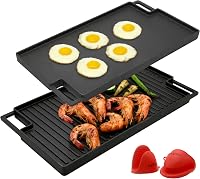
Uniflasy Cast Iron Griddle for Stove Top, 23 x 16 Inches
The Uniflasy griddle suits large batches on a gas grill, a wide oven, or a 4-burner range. It measures 23 by 16 by 2.6 inches and lists a maximum temperature of 500 degrees F.
The matte porcelain enamel coating gives a smooth, nonstick-style surface that eases cleanup. Uniflasy says the coating is durable and scratch-resistant, and the cast iron body supports even heat distribution.
Reinforced ribs on the back help resist warping under high heat. The 2.6-inch sidewalls help contain food and liquids during large-batch cooking.
Trade-offs include size and fit. At 23 inches wide, it needs a large oven or grill surface, and you should measure rack space before you buy.
How do you choose between cast iron, nonstick, and enamel?
Cast iron suits high heat, searing, and long service with simple care. Choose cast iron when you want oven heat, grill marks, and a surface that builds seasoning over time.
Nonstick suits eggs, fish, and low-oil cooking with easy release. Choose nonstick when release matters more than maximum oven heat, and check the handle limit before oven use.
Enamel over cast iron suits acidic foods and easier cleanup. Choose enamel when you want cast iron heat retention with a smoother surface, and check knobs and lids for oven limits.
Stainless steel suits high heat and easy oven finishing without seasoning care. Choose stainless when you want fast heating and a surface that tolerates metal utensils and harsh scrubbing.
Our best cast iron skillet guide covers round cast iron for oven finishing. Our best enameled cast iron skillet guide covers enamel for searing and baking.
How do griddles fit into oven safe cookware?
Griddles are flat, wide pans for breakfast, smash burgers, vegetables, and batch cooking. A reversible griddle gives you a flat side for eggs and pancakes plus a grill side for searing.
The Lodge Pro-Grid and Lodge Reversible Cast Iron Grill/Griddle both use that dual-sided design. The Uniflasy griddle uses a wide flat surface with high sidewalls for larger batches.
Griddle size changes where you can use it. A 20-inch or 23-inch griddle needs wide rack space, while a 16.75-inch griddle fits more ovens and stovetops.
Our best electric range griddle guide helps if you cook on electric heat. Our best lodge cast iron skillet accessories guide helps you protect and clean cast iron after oven use.
How do you care for oven safe cookware?
Care depends on the surface, so follow the maker guidance for your exact material. Dry cast iron on heat, clean nonstick gently, and check enamel for chips after oven use.
For seasoned cast iron, wash with warm water, dry fully, and apply a light coat of oil. Lodge describes its seasoned cast iron as easy to clean with proper care.
For nonstick, use soft utensils and avoid metal scrubbing that can damage the coating. The Kitchen Academy set is hand-wash recommended in its maker data.
For enamel, avoid sudden cold water on a hot pan, since thermal shock can chip the surface. Let the pan cool before washing, and check edges for damage.
Our is it safe to use a dented oven roasting pan guide explains when a dent matters. A dented or warped pan can heat unevenly, sit poorly on a rack, and spill food.
What safety checks should you do before heating a pan?
Check the pan body, handles, lid, and coating for damage before oven use. Replace or retire any pan with a loose handle, cracked coating, chipped enamel, or warped base.
Check that the pan fits the rack without touching the walls. A pan that touches the walls can heat unevenly and can scratch the oven interior.
Check that your path to the trivet is clear before you open the oven. Heavy cast iron needs two hands, and a hot griddle needs a stable landing spot.
Check your oven manual for rack position and broiler distance. The manual knows your oven's hot spots better than a general guide can.
Explore oven-safe cookware by topic
- Best Broiler Pans for Ovens
Which oven safe cookware fits your kitchen?
Pick cast iron for high heat, wide griddles, and long service. Pick the Lodge Pro-Grid for width, the Lodge Reversible for a smaller footprint, the Kitchen Academy set for everyday nonstick pots, or the Uniflasy griddle for large batches.
If you cook breakfast for several people, a reversible griddle earns its space quickly. If you cook mostly sauces and sides, a set with lids may serve you better.
If your oven is narrow, measure before you buy a 20-inch or 23-inch griddle. A smaller pan that fits well will outperform a larger pan that crowds the rack.
If you want matching pieces for daily oven work, start with our best oven safe cookware set roundup. Then add a best oven safe saute pan for searing and finishing.
Oven safe cookware works best when the rating, the handle limit, and the size all match your oven. Check those three points first, and the rest of the buying decision gets simpler.
Frequently asked questions
What makes cookware oven safe?
A maker rating for oven use up to a stated temperature makes cookware oven safe. Handles, knobs, lids, and coatings must also tolerate that heat.
If any part lacks a rating, keep that pan on the stovetop unless the maker confirms oven use in writing.
Can nonstick pans go in the oven?
Some nonstick pans are oven safe to a limited temperature, and some are not. The Kitchen Academy set in this guide has Bakelite handles rated to 350 degrees F for a limited time, so short oven use needs care.
Always check the handle limit, not just the pan body.
Is cast iron always oven safe?
Cast iron is generally oven safe because the pan body is iron, but handles, lids, and any added parts still matter. Lodge cast iron griddles in this guide list oven use for the pan itself.
Enameled cast iron also needs a check on knobs and lid limits.
What heat limit should I look for?
Look for a limit that covers your normal oven work, such as roasting, baking, or finishing a sear. A pan rated to 500 degrees F gives more headroom than one rated to 350 degrees F.
Broiler use needs a separate check because heat is direct and intense.
Do I need a full oven safe cookware set?
No, most cooks need one or two versatile pans first. A reversible griddle, a skillet, and a roasting pan cover most oven tasks.
A set makes sense when you want matching pots for sauces and sides, but start with the pieces you will use weekly.