
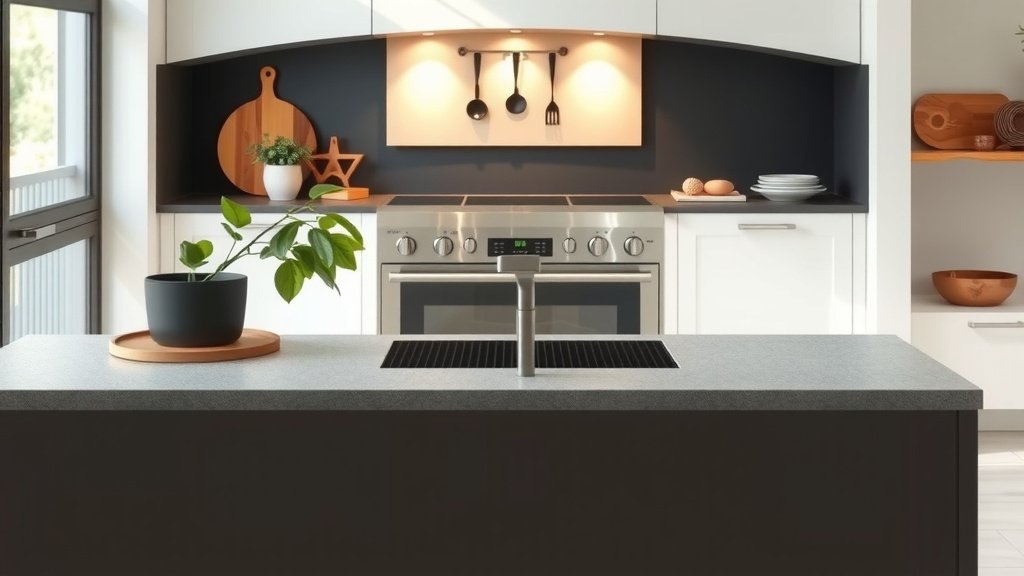
The ideal countertop oven size for you depends primarily on your kitchen space, cooking needs, and the number of people you regularly feed. For many individuals or smaller households, a versatile compact model ranging from 0.6 to 0.9 cubic feet often provides enough capacity.
To determine the perfect size countertop oven, consider your available counter space, typical cooking tasks (toasting, baking, roasting), and how many servings you prepare at once.
Here’s a quick overview of what to look for when choosing your countertop oven:
- Assess your kitchen layout: Measure your available counter space carefully.
- Match capacity to your household size: Bigger families need bigger ovens.
- Consider your cooking habits: Do you just toast, or do you roast chickens?
- Check power and features: Higher wattage means faster cooking.
- Don’t forget ventilation: Ensure proper airflow around the unit.
What Size Countertop Oven Do I Need?
Finding the right countertop oven size feels a bit like Goldilocks searching for the perfect bed. You want one that’s just right, not too big and not too small.
Your choice should really come down to your lifestyle, kitchen layout, and how you plan to use it.
Start with Your Lifestyle
Your daily routine and family size are huge factors here. A solo diner’s needs are very different from a family of five, wouldn’t you agree?
Think about how many meals you cook at home and for how many people.
Solo Chef or Small Family?
If you’re cooking for just yourself or a couple, a smaller oven makes sense. You probably don’t need to roast a huge turkey.
Many experts say that a 0.6 to 0.9 cubic foot oven is generally sufficient for preparing individual meals or snacks.
Cooking for a Crowd?
When you’re feeding a family of four or more, or love to entertain, you’ll want more space. Imagine trying to bake a lasagna in a toaster-sized oven!
Research indicates that larger families often find a 1.0 to 1.2 cubic foot oven or more to be much more practical.
Space is the Real Estate King
Countertop real estate is precious in any kitchen. You certainly don’t want your new oven to take over your entire workspace, do you?
Before you even look at features, grab a measuring tape.
Measuring Your Counter Space
Measure the width, depth, and height of the area where you plan to place the oven. Remember to account for opening the oven door.
We’ve found that leaving a few inches of clearance on all sides is a good rule of thumb for safety and air circulation.
Ventilation Needs
Countertop ovens generate heat, just like their full-sized cousins. They need room to breathe.
Many manufacturer guidelines suggest at least 4-6 inches of clearance from walls and overhead cabinets to prevent heat damage (Manufacturer Manuals).
Consider Your Culinary Habits
What do you actually cook most often? Your cooking style plays a major role in the oven size you’ll need.
Are you a master baker or more of a toast connoisseur?
Toasting and Bagels Only?
If your main use is toast, bagels, or warming up small snacks, a very compact toaster oven will likely do the trick. These are often the smallest models available.
They are quick, efficient, and perfect for light duty kitchen tasks, saving you energy compared to a full-sized oven.
Roasting and Baking Enthusiast?
Do you enjoy baking cookies, roasting a whole chicken, or making casseroles? You’ll need an oven with enough internal capacity to fit these items.
We found that ovens that can fit a 9×13 inch baking pan or a whole chicken are popular among those who bake or roast regularly.
Air Frying and Dehydrating?
Some modern countertop ovens do so much more than just bake. Many now feature air frying, dehydrating, and even rotisserie functions.
If you want these versatile features, you might need a slightly larger model to accommodate the necessary accessories, like an air fry basket.
Power and Features Matter
Beyond size, the oven’s power and available features directly impact its performance and your cooking experience.
Don’t overlook these details when making your final decision.
Wattage and Performance
Higher wattage generally means faster preheating and cooking. If you’re always in a hurry, a powerful oven is a good friend to have.
Research suggests that ovens with 1500 watts or more tend to offer quicker, more even cooking results.
Smart Features and Presets
Do you want an oven with preset cooking functions for pizza or toast? What about a digital display and precise temperature control?
These extra features can make cooking easier, but they sometimes come with a slightly larger footprint or price tag.
Common Countertop Oven Sizes & Uses
Let’s break down typical sizes to give you a clearer picture of what might suit you best.
| Oven Capacity (Cu. Ft.) | Typical Use Cases | Best For |
|---|---|---|
| 0.4 – 0.6 | Toast, reheat slices, small snacks | Singles, dorm rooms, quick office meals |
| 0.7 – 0.9 | Frozen pizzas, small roasts, 4-slice toast, baking small batches | Couples, small families (2-3 people), moderate cooking |
| 1.0 – 1.2+ | Whole chickens, casseroles, multiple dishes, large pizzas | Larger families (4+ people), entertaining, serious home cooks |
Checklist: Your Countertop Oven Size Decision
Use this quick checklist to guide your choice. It’s like a tiny roadmap for your oven journey!
- How many people will you cook for daily?
- What are your most common cooking tasks (toasting, baking, roasting, air frying)?
- How much free counter space do you have, considering clearances?
- What’s your power outlet situation like – do you have enough dedicated circuits?
- Are advanced features, like convection or specific presets, important to you?
- What’s your budget? Bigger ovens often mean bigger prices.
Conclusion
Choosing the right countertop oven size doesn’t have to be a guessing game. By thoughtfully considering your lifestyle, available kitchen space, and cooking aspirations, you can easily narrow down the options.
Remember to measure twice, think about what you truly need, and then select an oven that will seamlessly integrate into your kitchen and cooking routine. A well-chosen countertop oven will become a much-loved kitchen assistant, making your daily meals easier and more delicious.
How do I measure a countertop oven’s capacity?
Countertop oven capacity is typically measured in cubic feet (cu. ft.) or by the number of slices of toast it can hold. Look for this specification in the product details, which gives you a good idea of its internal space for various dishes.
Can a small countertop oven roast a chicken?
It depends on the specific oven’s internal dimensions and the size of the chicken. While some compact ovens can roast a small broiler chicken (around 3-4 pounds), larger birds usually require a medium to large countertop oven, typically 0.9 cubic feet or more, to fit properly.
Is a convection countertop oven always larger?
Not necessarily. Convection refers to a fan that circulates hot air, which can be found in various sizes of countertop ovens. While larger models are more likely to include convection, you can find smaller, compact convection ovens designed for efficient, even cooking.
What is the ideal wattage for a good countertop oven?
We found that many experts consider an ideal wattage for a capable countertop oven to be around 1500 to 1800 watts. This range generally provides sufficient power for quick preheating, effective baking, and efficient roasting without drawing too much energy.
Should I get a countertop oven with air fryer capabilities?
If you enjoy crispy foods without deep frying or want to maximize your kitchen appliance’s versatility, an oven with air fryer capabilities is a great choice. It can save counter space by combining two functions into one unit, though these models might be slightly larger than basic toaster ovens.
