9 Best Pizza Dough Proofing Boxes (November 2026)
The best pizza dough proofing boxes include the GSM Brands Pizza Dough Proofing Box for most home bakers, the Chef Pomodoro Pizza Dough Proofing Box for 4 to 6 dough balls, and the Brod & Taylor Proofing Container for bread and sourdough.
On this page (8 sections)
- How we compared these pizza dough proofing boxes
- The best pizza dough proofing boxes for bulk and individual proofing
- How to pick the best pizza dough proofing box for your fridge
- How do you use a pizza dough proofing box step by step?
- Which pizza dough proofing box is best for bread and sourdough?
- How to make pizza dough for a pizza oven with these boxes?
- What material and care should you expect?
- Verdict: which best pizza dough proofing box should you buy?
The best pizza dough proofing box for most home bakers is the GSM Brands model, with 2 large trays, covers and a stackable design.
Our score weighs specs, features and buyer feedback against what you are shopping for.
A proofing box does more than hold dough.
It keeps balls from touching, limits drying and makes fridge storage tidy.
That matters when you proof for several pizzas at once.
It also helps when you want dough ready before guests arrive.
If you also want a stand mixer for mixing, pair it with one of these boxes for the full dough workflow.
Start with the quick picks below, then compare size and care.
Check fridge fit before you choose, because large trays need wide shelves.
Our picks at a glance
-
1

-
2
 Best for 4 to 6 dough balls
Chef Pomodoro Pizza Dough Proofing Box
9.6/10 our score
See it on Amazon -
3

- 4
 Check it
Chef Pomodoro Pizza Proofing Box
Best for grey stackable storage - 5
 Check it
Hans Grill Pizza Dough Proofing Box
Best for a 2 pack large set - 6
 Check it
KEVJES PLUS-Large 1000ml Pizza Dough Proofing Boxes
Best for individual large balls - 7
 Check it
GATBO Pizza Dough Proofing Box with Lid
Best for FIFO labels - 8
 Check it
KEVJES PLUS 1000ml Pizza Dough Proofing Containers
Best for 4 individual containers - 9
 Check it
ooni Pizza Dough Proofing Box with Lid
Best for 250 gram balls
How we compared these pizza dough proofing boxes
We compared size, capacity, lid design, material, stacking and care instructions across 9 models.
We checked specs for dough ball counts, fridge fit and dishwasher safety.
That process helps separate bulk trays from individual containers.
It also helps separate airtight lids from vented lids.
Large trays suit bulk proofing.
Individual silicone boxes suit separate balls.
Translucent walls help you check rise without opening the lid.
We looked at who each box suits best.
We also noted where hand wash only care may annoy busy cooks.
Size matters in daily use because a tray that fills a shelf can slow prep.
Care matters too because sticky dough residue is part of routine cleaning.
No single box fits every kitchen, so trade offs stay central to this guide.
The best pizza dough proofing boxes for bulk and individual proofing
Each pick below names who it suits and the trade off against the others. Use the comparison table after the write ups to check dimensions side by side.
GSM Brands Pizza Dough Proofing Box: Best for most home bakers
- 17.25 x 13 x 3.54 inches
- 2 trays and covers
- BPA free plastic
- Stackable
A large commercial grade tray set that suits bulk proofing and fridge storage.
Pros
- Large 17.25 x 13 inch footprint
- Two trays and covers
- Stacks to save storage space
Cons
- Hand wash only
- Large footprint needs fridge space
The GSM Brands box suits home bakers who proof several pizzas at once and need a simple tray set. It measures 17.25 x 13 x 3.54 inches and includes 2 trays and covers, so you can run two batches or keep one tray for proofing and one for storage.
The plastic is BPA free and food grade, with a snap closure type. That snap cover helps hold humidity around the balls while they rise, which reduces dry skin compared with an open bowl.
Stacking is the practical win here. GSM Brands says the basins stack together when covers are removed, which saves cupboard space between pizza nights.
The rectangular shape also fits many fridge shelves, but you should measure first because 17.25 inches is a large footprint.
Care is hand wash only, so it is less convenient than dishwasher safe options on this list. If you want dishwasher care, compare the Chef Pomodoro grey box or the Hans Grill 2 pack.
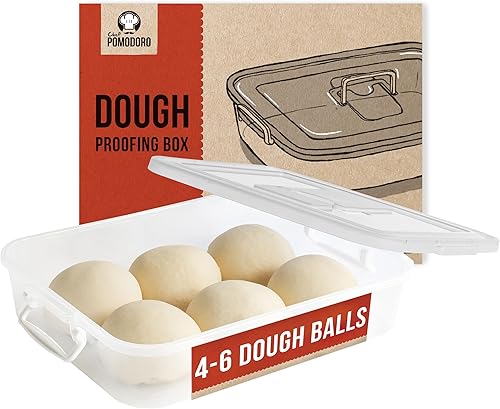
Chef Pomodoro Pizza Dough Proofing Box: Best for 4 to 6 dough balls
- 14 x 11 x 3 inches
- Snap lid
- Transparent and stackable
- Carry handle
A clear lidded box sized for 4 to 6 dough balls for 12 to 14 inch pizzas.
Pros
- Fits 4 to 6 dough balls
- Transparent walls for checking rise
- Snap lid and carry handle
Cons
- Hand wash only
- Smaller than the largest trays
The Chef Pomodoro blue box suits small households making 4 to 6 balls for 12 to 14 inch thin crust pizzas.
It measures 14 x 11 x 3 inches and is sized so fully proofed dough does not touch the lid.
That headroom helps balls rise without pressing against the cover.
It also keeps the surface of the dough from drying where it touches plastic.
The snap lid seals in moisture and helps you control humidity during proofing.
That sealed environment supports softer, more hydrated dough than an ordinary storage container, according to Chef Pomodoro.
Transparency is useful in daily use.
You can check the rise through the walls without lifting the lid and losing humidity.
The trays also stack, and the recess handle helps with storage.
A carry handle and snap clasps make moving the box easier when you are cooking for a crowd.
That handle helps on the trip from counter to fridge.
It can also help when dough moves to a prep table for pizza night.
Care is hand wash only, which is the main trade off versus the grey Chef Pomodoro version below that is dishwasher safe.
Brod & Taylor Proofing Container: Best for bread and sourdough
- 2 pack, 6L capacity
- Fits up to 3000 grams of dough
- Translucent walls with markings
- Dishwasher safe
A 2 pack translucent container set for tracking rise without opening the lid.
Pros
- Volume markings track dough rise
- Holds up to 3000 grams
- Dishwasher and freezer safe
Cons
- No fixed dough ball count
- Smaller footprint than large trays
The Brod & Taylor Proofing Container suits bread, sourdough and pizza bakers who want to track rise by volume. This 2 pack has 6L capacity and fits up to 3000 grams of dough across the set.
Translucent walls and volume markings let you see when dough is ready without opening the lid. That helps avoid over fermentation and keeps humidity steadier during the proof.
The lid seals in moisture to keep dough soft and prevent dry skin. Brod & Taylor says the low profile containers stack inside its Folding Proofer at 10.5 x 12.8 x 4 inches, and they stack with or without lids.
Polypropylene is BPA free and resists stains and odors, according to Brod & Taylor. It is dishwasher safe and freezer friendly, which helps with sticky high hydration dough.
The trade off is that it is not sold as a fixed dough ball tray. If you need a clear count of 6 balls, a large tray may be simpler.
Chef Pomodoro Pizza Proofing Box: Best for grey stackable storage
- 14 x 11 inches
- Fits 4 to 6 dough balls
- Snap lid
- Dishwasher safe
A grey version of the 14 x 11 inch box with dishwasher safe care.
Pros
- Fits 4 to 6 dough balls
- Dishwasher safe
- Transparent and stackable
Cons
- Grey color may not suit all kitchens
- Single box not a multi pack
The Chef Pomodoro grey box suits buyers who want the same 14 x 11 inch format as the blue model but with dishwasher safe care. It fits 4 to 6 dough balls sized for 12 to 14 inch thin crust pizzas.
The snap lid helps hold temperature and humidity around the dough. Chef Pomodoro says that environment supports complex flavor development and a chewier texture, and helps keep dough from drying compared with ordinary containers.
Transparent, stackable trays let you check rising dough without removing the lid. The carry handle and snap shut clasps help when you move dough from counter to fridge or to a prep area.
Plastic is BPA free and food grade. Care is dishwasher safe, which is a clear advantage over the blue version that is hand wash only.
The trade off is color and pack size. It is a single grey box, while some picks here come as 2 packs.
Choose it for care convenience and a neutral look.
Chef Pomodoro Pizza Dough Proofing Box: Best for 4 to 6 dough balls
- 14 x 11 x 3 inches
- Snap lid
- Transparent and stackable
- Carry handle
A clear lidded box sized for 4 to 6 dough balls for 12 to 14 inch pizzas.
Pros
- Fits 4 to 6 dough balls
- Transparent walls for checking rise
- Snap lid and carry handle
Cons
- Hand wash only
- Smaller than the largest trays
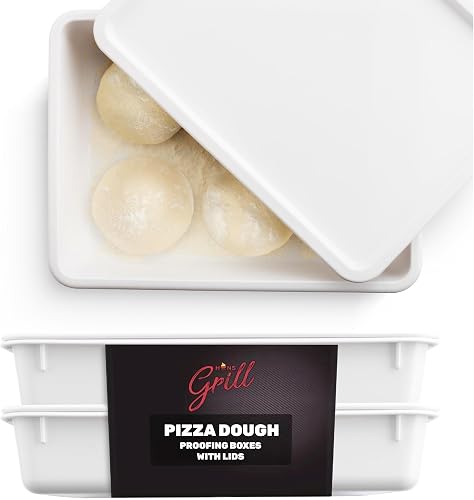
Hans Grill Pizza Dough Proofing Box: Best for a 2 pack large set
- Pack of 2
- 17.32 x 12.99 x 3.54 inches
- BPA free trays with covers
- Dishwasher safe
Two large stackable trays that each fit up to 6 dough balls.
Pros
- Two large containers
- Fits up to 6 dough balls each
- Stacks with or without lids
Cons
- Dishwasher safe but large in fridge
- Needs shelf clearance check
The Hans Grill 2 pack suits large families and home chefs who want two stackable trays with covers. Each container measures 17.32 x 12.99 x 3.54 inches and fits up to 6 dough balls for personal pizzas.
The BPA free plastic trays stack in the fridge and kitchen to keep prep space tidy. You can use them with lids or without lids, depending on whether you need humidity for proofing or open storage for ingredients.
Hans Grill says the containers also work for sourdough or yeast dough and for storing fruit and vegetables when not used for dough. That multi use helps if you want one set for several kitchen jobs.
Care is dishwasher safe, which suits busy households. The included components list lids, and the pack size is 2 containers.
The trade off is fridge space. Two large trays need shelf clearance, so measure your shelves before ordering.
If you need individual balls separated, the KEVJES 1000ml boxes may suit better.
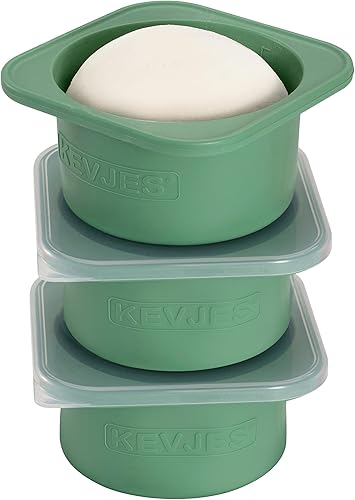
KEVJES PLUS-Large 1000ml Pizza Dough Proofing Boxes: Best for individual large balls
- 1000ml capacity
- 6.2 x 6.2 x 3.3 inches
- Food grade silicone
- Steel reinforced
Individual 1000ml silicone boxes for large dough balls up to 300 grams.
Pros
- Individual proofing prevents sticking
- Freezer, fridge and dishwasher safe
- Steel reinforced silicone
Cons
- Individual boxes take more shelf space
- Not a bulk tray
The KEVJES PLUS Large 1000ml set suits bakers who want each dough ball proofed on its own. Each box measures 6.2 x 6.2 x 3.3 inches and holds 1000ml, sized for a 300 gram dough ball.
Individual proofing prevents balls from sticking together and helps each pizza keep a uniform shape. That is useful for family size pizzas from 12 to 16 inches, according to KEVJES.
The boxes use food grade silicone with a reinforced steel frame. The steel inlay adds stability so the box holds its shape when you carry it, while silicone stays flexible for storage.
Airtight clear lids protect dough from drying and odors during fridge or freezer storage. KEVJES recommends spraying oil inside before adding dough to help the ball slide out.
It is freezer safe, fridge safe and dishwasher safe. The trade off is that individual boxes use more shelf space than one bulk tray when you proof many balls.
GATBO Pizza Dough Proofing Box with Lid: Best for FIFO labels
- 15.67 x 11.69 x 4.09 inches
- Fits up to 6 dough balls
- Label sticker and markers
- Polypropylene, BPA free
A lidded commercial box with label sticker and 2 erasable markers.
Pros
- Label sticker and markers included
- Fits up to 6 dough balls
- Stacks with or without lids
Cons
- Non airtight lid
- Single box
The GATBO box suits commercial and home kitchens that need batch labels.
It measures 15.67 x 11.69 x 4.09 inches and fits up to 6 dough balls with room for expansion.
That extra depth helps when dough rises high in the tray.
It also gives more room than shallower boxes for active fermentation.
Food grade polypropylene is BPA free, stain resistant and light, according to GATBO.
The containers stack securely with or without lids, which helps organize a prep station or fridge.
Stacking with lids helps during proofing when humidity matters.
Stacking without lids helps when trays are empty and need storage.
A label sticker and 2 erasable markers are included for dates, dough types or batch info.
That FIFO system helps if you proof ahead for several days.
It also helps in a shared kitchen where more than one dough batch is in use.
The lid is intentionally non airtight to allow slight airflow and reduce condensation.
That supports natural fermentation for pizza, bread and sourdough, but it is different from airtight picks if you want maximum humidity retention.
Care is dishwasher safe.
The trade off is a single box rather than a multi pack, so add a second if you proof large batches often.
KEVJES PLUS 1000ml Pizza Dough Proofing Containers: Best for 4 individual containers
- 4 sets, 1000ml each
- 6.2 x 6.2 x 3.3 inches
- Silicone with lids
- Freezer safe
Four 1000ml silicone containers for family size pizzas and prep ahead dough.
Pros
- Four containers in the set
- Holds a 300 gram dough ball
- Airtight clear lids
Cons
- Individual format not bulk proofing
- Four boxes need storage planning
The KEVJES PLUS 4 set suits bakers who prep ahead and want 4 individual containers.
Each box is 1000ml at 6.2 x 6.2 x 3.3 inches, sized for a 300 gram ball and 12 to 16 inch family pizzas.
Separate compartments stop balls touching, which reduces sticky dough and helps each ball rise on its own.
That separation also makes it easier to bake one pizza at a time.
You can keep the rest cold while the first ball comes up to room temperature.
BPA free silicone has a reinforced steel frame for stability.
The steel inlay helps the box hold its shape during carrying and stacking.
That matters when several boxes move from fridge to counter in one trip.
The clear lids are airtight to lock in moisture and keep odors out during fridge or freezer proofing.
Air tight lids also help with longer cold ferments where dry skin is a risk.
The set includes lids and silicone boxes in green, blue, gray and space gray.
Different colors can help you track batches or separate one dough type from another.
Care is dishwasher safe, freezer safe and refrigerator safe.
The trade off is format.
Four small boxes take more planning than one large tray, and they suit individual balls rather than bulk proofing a full batch together.
ooni Pizza Dough Proofing Box with Lid: Best for 250 gram balls
- 16.65 x 12.72 x 3.66 inches
- 2 trays and lids
- Fits six 250 gram balls
- Dishwasher safe
Two stackable trays sized for six 250 gram dough balls for 12 inch pizzas.
Pros
- Two trays and lids
- Sized for 250 gram balls
- Dishwasher safe and stackable
Cons
- Check fridge shelf fit
- Large footprint
The ooni box set suits pizza oven owners who proof 250 gram balls for 12 inch pizzas. Each tray measures 16.65 x 12.72 x 3.66 inches and fits up to six 250 gram dough balls.
The set includes two stackable boxes and lids. Lids keep dough balls from drying out on the counter, in the fridge or in the freezer, according to ooni.
Stackable trays nest to save space when storing or moving dough. That helps if you proof in the fridge and then move trays to a prep bench.
Care is dishwasher safe and the trays are made from recycled plastic, according to ooni. The shape is rectangular with a lift off lid.
The trade off is shelf fit. ooni says the tray fits most domestic fridge shelves, but you should check your shelf dimensions before ordering. It is also a single set rather than a larger multi pack.
ooni Pizza Dough Proofing Box with Lid: Best for 250 gram balls
- 16.65 x 12.72 x 3.66 inches
- 2 trays and lids
- Fits six 250 gram balls
- Dishwasher safe
Two stackable trays sized for six 250 gram dough balls for 12 inch pizzas.
Pros
- Two trays and lids
- Sized for 250 gram balls
- Dishwasher safe and stackable
Cons
- Check fridge shelf fit
- Large footprint
How to pick the best pizza dough proofing box for your fridge
Measure your fridge shelf first. Large trays at 17 x 13 inches and 16.65 x 12.72 inches need wide shelves.
Smaller 14 x 11 inch boxes fit more shelves.
Tray or individual containers?
Choose a tray for bulk proofing 4 to 6 balls together. Choose individual 1000ml boxes for separated balls and prep ahead storage.
Our guide on how to use a pizza dough proofing box walks through both methods.
What size fits your pizza?
Match ball count to your usual pizza size. Six 250 gram balls suit 12 inch pizzas.
Four to 6 balls for 12 to 14 inch pizzas suit the Chef Pomodoro boxes.
Lidded or non airtight?
Airtight lids hold humidity and limit dry skin during cold proofing. The GATBO lid is non airtight by design for airflow.
Pick airtight for fridge storage and a vented style for condensation control.
How do you use a pizza dough proofing box step by step?
Oil the box, add balls with space to rise, close the lid and proof at your recipe temperature.
Check rise through clear walls when you can.
Start with a light coat of oil in the tray or individual box.
That step helps dough release with less tearing at shaping time.
Add balls with space between them so they do not stick as they expand.
In a bulk tray, spread balls so each one has room on all sides.
In an individual box, one ball per container keeps the shape round.
Close the lid to hold humidity around the dough.
For counter proofing, check the rise at intervals without opening the lid if walls are clear.
For fridge proofing, stack trays only when lids are secure.
That stacking keeps shelves tidy and frees space for other ingredients.
Label a tray if you proof more than one batch.
Date and dough type labels help with first in first out rotation.
Learn the full routine in how to use a pizza dough proofing box.
For bread loaves, compare our best bread proofing box guide.
If you mix dough with a machine, our stand mixer guide helps you choose capacity.
For oven proofing, see the Best Toaster Oven For Proofing Dough guide.
Time the last step close to baking so balls stay plump.
Take out only what you need and keep the rest covered.
That habit protects texture and keeps handling simple.
Which pizza dough proofing box is best for bread and sourdough?
The Brod & Taylor container is the best cross use pick here, because it holds up to 3000 grams and has volume markings. Large trays also suit bread dough if capacity fits.
Volume markings or ball count?
Volume markings help with bread and sourdough folds. Ball counts help with pizza batches.
Choose markings for loaves and ball counts for pizza night.
Folding proofers and space saving
Bread proofing needs room for bulk dough and for folds.
A pizza tray can work, but volume markings make rise easier to track.
That is why the Brod & Taylor container stands out for bread and sourdough here.
If you use a folding proofer, check internal dimensions.
Our best folding bread proofing box guide covers compact options.
You can also learn how to use a bread proofing box for general technique.
Measure the proofer before you buy a tray.
A box that fits with room to spare is easier to load and remove.
Low profile boxes can also stack in a proofer to save space.
That setup suits bakers who proof more than one dough at a time.
How to make pizza dough for a pizza oven with these boxes?
Proof balls in a lidded box, keep them separated, and take them out close to baking time.
That keeps shape and hydration steady.
Pizza oven dough needs balls that hold their round shape until shaping.
A lidded box helps by limiting air exposure during proofing.
Separated balls also reduce sticking at the edges.
That matters when you stretch dough fast before it goes into a hot oven.
Cold proofing in the fridge gives flavor time to build.
It also lets you prep dough ahead for a busy evening.
Take one ball out at a time and leave the rest covered.
That keeps the remaining balls from drying while you work.
For dough recipes and timing, read How To Make Pizza Dough For Pizza Oven?.
Pair proofing with a hot oven and a peel for best crust.
A steady proof plus a hot bake gives a more even rise.
It also helps the crust set before the center overcooks.
Choose a box that fits your fridge shelf and your usual ball size.
That match makes oven night run more smoothly.
Cold proofing in the fridge
Use airtight lids and stackable trays for cold proofing. Individual silicone boxes also work well for fridge and freezer storage.
What material and care should you expect?
Plastic trays are common and dishwasher safe on many picks, while silicone boxes are freezer safe.
Check care for each model before ordering.
BPA free plastic and food grade silicone are listed across these picks.
Plastic trays are light and easy to stack in most fridges.
Silicone boxes flex a little, which can help with storage in tight spaces.
Steel reinforced silicone holds shape better during carrying.
Hand wash only models include GSM Brands and the blue Chef Pomodoro box.
That care may suit small kitchens where washing one tray by hand is quick.
Dishwasher safe models include Hans Grill, KEVJES and ooni.
Dishwasher care can save time after a busy pizza night.
Freezer safe models help when you want dough ready for later in the week.
Fridge safe storage also helps with cold fermentation.
Clean sticky residue soon after use to keep lids sealing well.
A clean lid helps hold humidity and keeps odors out.
Check stacking before you buy if shelf space is tight.
Verdict: which best pizza dough proofing box should you buy?
Buy the GSM Brands box for most home bakers, the Chef Pomodoro 14 x 11 inch box for 4 to 6 balls, or Brod & Taylor for bread and sourdough.
Each solves a different proofing job.
Pick a large 2 pack tray if you proof often and have fridge space.
That choice suits bulk batches and frequent pizza nights.
Pick individual 1000ml silicone boxes if you prep ahead and want balls separated.
That choice suits meal prep and family size pizzas.
Pick translucent volume marked containers if you track rise for bread.
That choice suits sourdough and high hydration dough.
Measure your fridge shelf before you order any tray.
Large trays need wide shelves and clear height.
Smaller boxes fit more shelves but hold fewer balls.
Match the box to your usual pizza size.
Six 250 gram balls suit 12 inch pizzas in several picks here.
Four to 6 balls for 12 to 14 inch pizzas suit the Chef Pomodoro boxes.
Check care instructions as part of the decision.
Hand wash only may be fine for one tray but dull for several.
Dishwasher safe care can matter more than small feature differences.
Start with the top pick, measure your fridge shelf, and match the box to your usual pizza size.
That choice matters more than extras.
Our top 3 picks at a glance
-
1
-
2
Best for 4 to 6 dough balls
Chef Pomodoro Pizza Dough Proofing Box
9.6/10 our score
See it on Amazon -
3
Frequently asked questions
How many dough balls fit in a proofing box?
It depends on box size and ball weight. Large trays here fit up to 6 dough balls, while the 14 x 11 inch Chef Pomodoro boxes fit 4 to 6 balls for 12 to 14 inch pizzas.
Individual 1000ml boxes proof one large ball at a time.
Can a pizza dough proofing box be used for bread?
Yes, many of these boxes suit bread and sourdough as well as pizza. The Brod & Taylor container holds up to 3000 grams of dough and has volume markings.
Check the recommended uses and capacity before using a tray for a large loaf.
Do lids need to be airtight?
Most lids here seal to hold humidity and prevent drying. The GATBO lid is non airtight by design to allow slight airflow and reduce condensation.
Choose airtight for cold fridge proofing if you want to limit dry skin.
How do I choose between a tray and individual containers?
Choose a tray for bulk proofing several balls together and stacking in the fridge. Choose individual 1000ml containers when you want each ball separated so it does not stick to neighbors.
Measure your fridge shelf first in both cases.


