
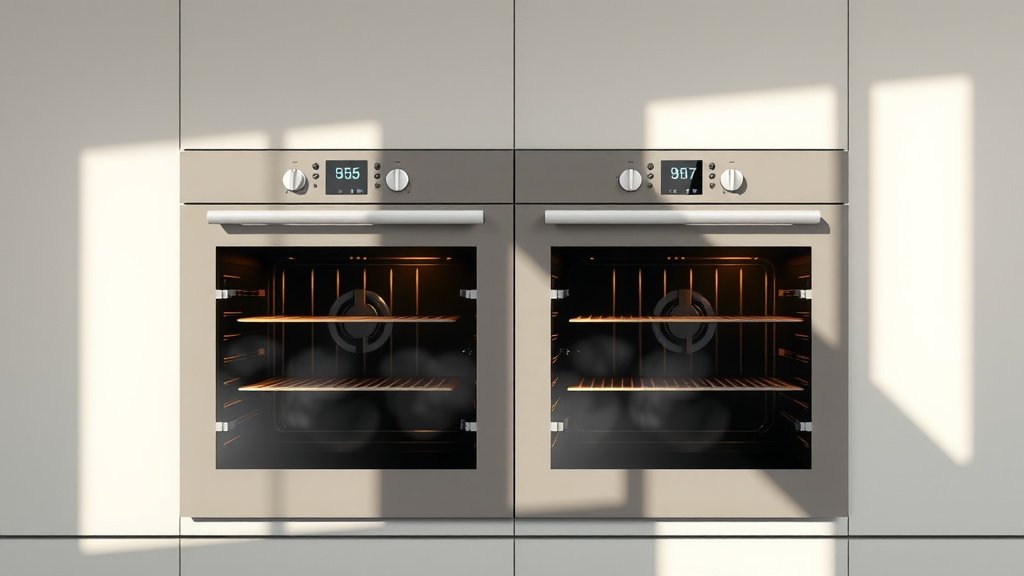
Double oven cavities often show temperature variations due to size, heating elements, and airflow, with the smaller cavity typically heating faster or having slightly different hot spots.
These temperature differences mean you might need to adjust cooking times or rack positions when using both ovens simultaneously to achieve optimal results.
TL;DR:
- Double ovens rarely hold identical temperatures in both cavities.
- Size, heating element placement, and air circulation are key factors in these variations.
- Using an independent oven thermometer is vital for accurate temperature checks.
- Adjusting cooking times and rotating dishes can help overcome temperature inconsistencies.
- Understanding your specific oven’s quirks leads to better baking and roasting.
How Does Temperature Vary Between Double Oven Cavities?
Double oven cavities frequently have different temperatures, influenced by their individual sizes, heating elements, and internal air circulation patterns.
These differences are normal, but understanding them helps you master your cooking.
Why Don’t They Stay Identical?
It’s a common misconception that both ovens will be exactly the same inside. Think of them as two separate cooking zones.
Each zone has its own characteristics, impacting how heat moves and settles.
The Role of Size and Volume
Typically, one cavity is larger than the other. A smaller cavity often heats up more quickly and can even hold a slightly higher temperature.
The larger cavity takes more energy and time to reach and maintain its set temperature because it has more space to heat.
Understanding Heating Elements
The placement and power of heating elements play a big role. Some ovens have distinct top and bottom elements in each cavity.
We found that in some models, the elements might be optimized differently for each oven, leading to unique heating profiles.
Airflow: A Silent Contributor
Good airflow is key for even baking. In a double oven, each cavity has its own ventilation system, often with different vent locations.
Any disruption to this airflow, like large baking sheets blocking vents, can create hotter or cooler zones within the oven.
Top vs. Bottom Cavity Differences
Many users report consistent temperature variations between the upper and lower oven.
The upper oven is generally smaller and sometimes preferred for quicker bakes or broiling, while the lower might be better for larger roasts.
Here’s a simple look at potential differences:
| Cavity Type | Typical Characteristics | Best Use Cases |
|---|---|---|
| Upper Oven | Often smaller, heats faster, can be slightly hotter. | Pizzas, cookies, casseroles, broiling. |
| Lower Oven | Often larger, heats slower, can be slightly cooler. | Large roasts, turkeys, multiple dishes, slow cooking. |
Hot Spots and Cold Zones
Just like a single oven, double ovens can develop hot spots. These are areas that consistently run hotter than the set temperature.
Cold zones are the opposite, areas where food might cook slower or unevenly (National Institute of Standards and Technology).
Identifying Your Oven’s Quirks
You can identify these zones by baking a batch of cookies or toast on a single sheet across different racks.
Look for areas that brown faster or slower; this gives you clues about your oven’s unique heat distribution.
Calibrating Your Double Oven
Don’t just trust the dial! Oven thermostats can drift over time, and factory settings might not be perfectly accurate.
Calibrating helps ensure your oven reaches the temperature you set.
Using an Oven Thermometer
This is your best friend for accurate temperatures. Place a reliable oven thermometer in the center of each empty oven cavity.
Preheat to a common temperature like 350°F and check the thermometer after 20-30 minutes; it should match your setting.
Tips for Even Cooking
Once you know your oven’s tendencies, you can adapt your cooking methods. This flexibility will make you a better chef!
Remember, cooking is often about observation and adjustment.
Rotating Food for Success
If you notice one side of a dish cooking faster, simply rotate it halfway through the baking time.
This simple trick ensures more uniform results, especially with larger items or full baking sheets.
Adjusting Cook Times
When using both ovens, keep in mind that the combined heat can sometimes cause both cavities to run slightly cooler than if used alone.
You might need to add a few extra minutes to cooking times, particularly if both are packed with food.
What About Convection?
Many modern double ovens include convection features. Convection uses a fan to circulate hot air, aiming for more even cooking.
If one cavity has convection and the other doesn’t, expect different cooking speeds and results between them.
When to Use Each Cavity
Thinking strategically about which oven to use can simplify your cooking.
Consider the dish, its size, and whether it benefits from a specific type of heat.
Practical Cooking Strategies
For dishes needing high, dry heat (like roasting vegetables), the smaller, potentially hotter upper oven might be ideal.
For delicate items (like cakes or soufflés), a more stable, lower-temperature environment in the larger oven might be better.
Before you start baking, consider this checklist:
- Calibrate Each Cavity: Check temperatures with an independent thermometer.
- Preheat Fully: Give your oven ample time to reach and stabilize the set temperature.
- Don’t Crowd the Oven: Leave space for air circulation around your dishes.
- Use Proper Bakeware: Dark pans absorb more heat; light pans reflect it.
- Rotate Your Dishes: Especially if you suspect hot spots.
Conclusion
Temperature variation between double oven cavities is a fact of kitchen life, not a flaw. Your double oven is a powerful tool, offering amazing flexibility for cooking multiple dishes at once.
By understanding these subtle differences and making small adjustments, you can truly master your appliance. Embrace the uniqueness of each cavity, and your culinary creations will thank you.
Frequently Asked Questions
Is it normal for a new double oven to have temperature differences?
Yes, it is entirely normal for even brand-new double ovens to show slight temperature variations between their cavities. These differences are often due to distinct design, size, and heating elements for each oven. We recommend testing with an oven thermometer upon installation to learn your specific unit’s characteristics.
Can I cook two different items in a double oven at different temperatures?
Absolutely! That’s one of the main advantages of a double oven. You can set each cavity to a completely different temperature, allowing you to roast a turkey in one while baking a pie in the other without compromise. Just be mindful of cooking smells if dishes are particularly aromatic.
How much temperature difference is too much in a double oven?
A variation of 15-25 degrees Fahrenheit from the set temperature is fairly common and usually manageable for home cooking. If your oven consistently shows differences of 50 degrees or more, or fluctuates wildly, it might indicate a need for calibration or professional service.
Does opening one oven door affect the temperature in the other?
Generally, opening one oven door will have a minimal, if any, direct impact on the temperature of the other sealed cavity. Modern double ovens are designed to operate independently. Short openings cause temporary heat loss in that specific cavity, but the other should remain stable.
Are convection settings the same in both double oven cavities?
Not always. Some double ovens feature convection in both cavities, while others may only have it in one (often the upper or larger one). Always check your oven’s manual to understand which cavities have convection and if there are different settings or fan speeds available.
