
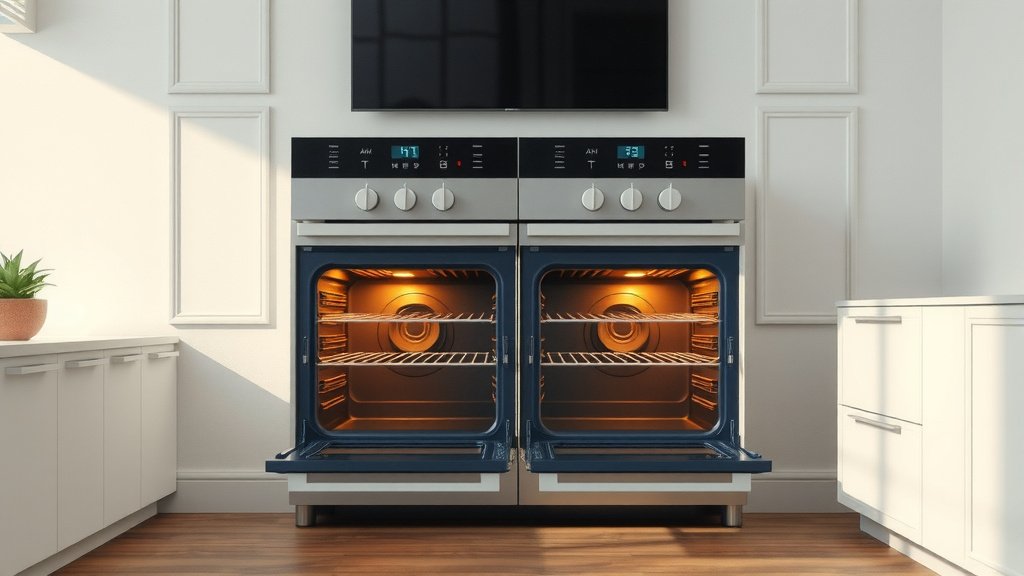
To use both cavities in a double oven, you can set distinct temperatures for each compartment, allowing you to cook diverse dishes like a roast and a dessert simultaneously.
This flexibility lets you efficiently manage meal preparation, ensuring everything finishes around the same time and at its ideal cooking setting.
Here’s a quick rundown of how to get the most from your double oven:
- Master the individual controls for each oven cavity.
- Plan your meal by grouping dishes based on their temperature needs.
- Utilize different temperatures in each oven for maximum versatility.
- Ensure adequate space around each dish for proper heat circulation.
- Consider using one oven for cooking and the other for keeping food warm.
How To Use Both Cavities In A Double Oven?
Using both cavities in a double oven effectively means you can cook different items at their ideal temperatures simultaneously.
It’s like having two separate ovens, each ready to handle its own task, transforming your kitchen efficiency.
Why a Double Oven is a Kitchen Essential
Imagine holiday meals or hosting a dinner party. A double oven becomes your best friend, freeing you from the common single-oven juggle.
No more waiting for the turkey to finish before you can bake the pie; you can tackle both at once.
The Power of Independent Temperatures
The core advantage is the ability to run each oven at a different temperature. Need to roast vegetables at 400°F and bake a delicate cake at 350°F?
Your double oven handles it without a hitch, giving you true culinary freedom.
Time-Saving Efficiency
We’ve found that using both ovens can drastically cut down on overall cooking time for larger meals.
Plus, for smaller tasks, you can often just use one cavity, which might preheat faster and potentially save energy compared to heating a large single oven.
Getting Acquainted with Your Appliance
Before diving into a dual-cavity cooking adventure, take a moment to understand your specific double oven model.
A quick read of the instruction manual can often clarify unique features and controls.
Upper vs. Lower Cavity Roles
Most double ovens have a larger lower cavity, ideal for big roasts and casseroles, and a smaller upper cavity, perfect for quick baking, broiling, or small side dishes.
The smaller oven often heats up faster, a handy detail for quick tasks.
Operating the Controls
Your oven’s control panel will have separate settings for each cavity. This lets you independently adjust temperatures, timers, and cooking modes.
Familiarizing yourself with these distinct controls prevents any accidental cooking mix-ups.
Smart Strategies for Dual Cooking
Ready to orchestrate a culinary symphony? Here are some practical ways to make both oven cavities sing in harmony.
Planning and smart placement are your key ingredients for success.
Temperature Pairing for Success
If you have two dishes needing the same temperature, like two trays of cookies at 375°F, you can use both ovens to speed up batch cooking.
The real advantage, though, is setting different temperatures for diverse recipes, making simultaneous preparation simple (Mayo Clinic).
Optimizing Rack Space and Airflow
Good air circulation is vital for even cooking. Try to leave at least an inch or two of space around each dish in both cavities.
We found that avoiding stacking pans directly above each other helps heat flow properly, reducing the risk of unevenly cooked food.
Preventing Flavor Mix-ups
Be mindful of strong smells. Baking a salmon fillet in one oven while making a delicate lemon meringue pie in the other might lead to unwanted flavor transfers.
Consider using separate ovens for dishes with very different aromatic profiles, or ensure strong seals on your baking dishes.
- Prepare Your Menu: Group dishes based on their required cooking temperatures.
- Full Preheat: Always preheat both ovens to their target temperatures before adding food.
- Use an Oven Thermometer: Many experts say built-in thermometers can be inaccurate; an external one provides assurance.
- Rotate if Needed: For very even results, especially in convection ovens, rotate dishes halfway through.
- Minimize Door Openings: Each time you open the door, heat escapes. Use the oven light to check food when possible.
Maximizing Your Double Oven’s Potential
Once you’re comfortable with the basics, you can explore even more sophisticated ways to utilize your double oven’s capabilities.
It’s about making your appliance work harder and smarter for you.
Keeping Food Warm While Others Cook
One fantastic use is to designate one cavity, often the smaller upper one, as a warming zone. Set it to a low temperature, around 170-200°F.
This allows you to hold finished dishes at serving temperature while other items continue to cook in the other oven (NIH).
Handling Multiple Timers
Many modern double ovens come equipped with independent timers for each cavity, which is incredibly helpful.
If your oven only has one, consider using external kitchen timers or your smartphone to manage the varied cooking durations.
| Oven Cavity | Typical Temp Range | Best For These Dishes | Quick Notes |
|---|---|---|---|
| Upper Oven (Smaller) | 325°F – 425°F | Cookies, Small Casseroles, Pies, Broiling, Quick Bakes | Often heats up faster, great for quick tasks or browning. |
| Lower Oven (Larger) | 300°F – 450°F | Roasts, Large Poultry, Bread, Sheet Pan Dinners, Bulk Cooking | More space for bigger items, frequently has convection option. |
Addressing Common Double Oven Queries
Even with two ovens, you might encounter a few hiccups. Don’t worry; most issues have straightforward solutions.
Dealing with Uneven Heat
Some ovens can have slight temperature inconsistencies. If you notice one part of your dish cooking faster, try rotating it halfway through.
Using a separate oven thermometer can also confirm if your oven is truly maintaining the set temperature (Consumer Reports).
Avoiding Oven Overcrowding
It’s tempting to cram as much as possible, especially during big meals. However, too many dishes block airflow, leading to uneven or slower cooking.
Allowing proper space around each item is key for consistent heat distribution and better results.
Checklist for Dual Oven Success
- Confirm both ovens are preheated to the correct individual temperatures.
- Verify there’s enough space around all dishes for optimal airflow.
- Set separate timers for each item or oven section.
- Place dishes with strong aromas in a dedicated cavity if possible.
- Use the oven light to check progress without opening the door.
- Consider using the larger, lower oven for items requiring longer cooking times.
Conclusion
Mastering both cavities of your double oven truly elevates your cooking experience, offering unmatched flexibility and efficiency for any meal.
By understanding its features, planning your cooking strategy, and implementing smart techniques, you can effortlessly manage diverse dishes and achieve perfect results every time.
Embrace the dual functionality to simplify your kitchen tasks and enjoy more delicious outcomes.
What are the main benefits of a double oven?
The primary benefits of a double oven include the ability to cook multiple dishes at different temperatures simultaneously, significantly reducing meal preparation time. It provides greater capacity for larger meals and offers enhanced flexibility for various cooking methods, such as roasting in one cavity while baking in another.
Can I use one cavity to warm food while another dish bakes?
Yes, this is one of the most practical uses of a double oven. You can set one cavity to a very low temperature, typically between 170-200°F, to keep cooked food warm, ensuring everything is hot when ready to serve. Meanwhile, the other oven can continue baking or roasting.
Do both cavities in a double oven always have identical features?
No, not typically. While some premium models might offer similar features in both, it’s more common for the larger, lower oven to include advanced settings like convection, self-cleaning, or specialized cooking modes. The smaller, upper oven might have more basic functions, often designed for quick tasks or broiling. Always check your appliance’s manual.
Is using both oven cavities at once energy-efficient?
For a large meal with multiple dishes, using both oven cavities simultaneously can often be more energy-efficient than cooking each dish sequentially in a single oven. This is because it reduces the total preheating time and keeps heat contained for a shorter overall duration. For smaller tasks, using only one smaller cavity is usually more efficient than heating a large single oven.
How do I prevent odors from mixing between the two oven cavities?
To minimize odor transfer, try to cook strongly aromatic foods, such as fish or garlic-heavy dishes, in a separate cavity from delicate items like cakes or pastries. Ensuring that strong-smelling dishes are covered tightly can also help. Research suggests that separate ventilation systems in double ovens generally reduce odor mixing effectively.
