
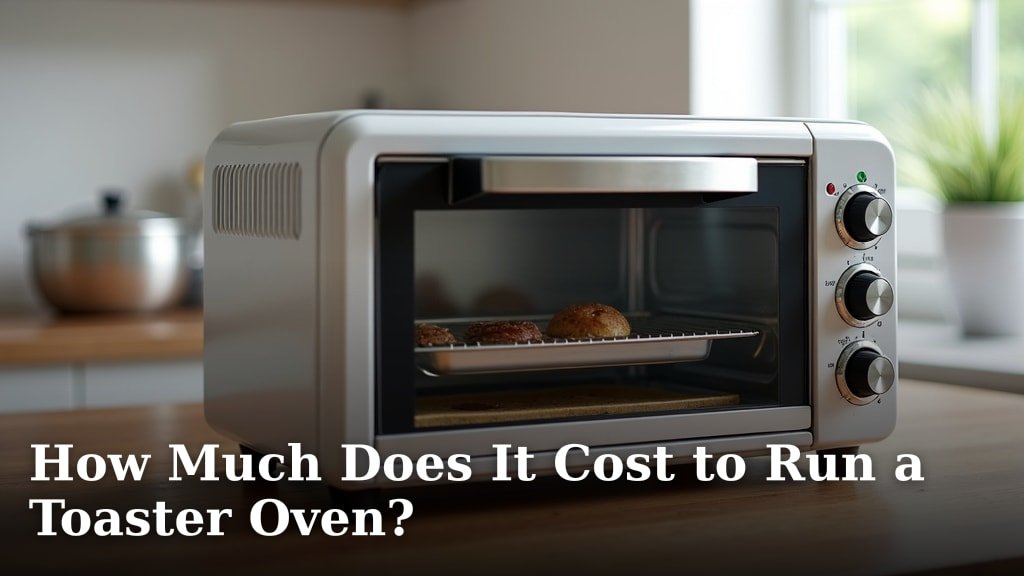
Running a toaster oven typically costs between $0.05 and $0.15 per hour of use. This estimate depends on your electricity rate, the toaster oven’s wattage, and how long you use it. The exact cost to run a toaster oven can vary quite a bit.
You might be surprised how much those convenient kitchen appliances add to your electricity bill. We found that toaster ovens generally use between 1,200 and 1,800 watts of power. Knowing your appliance’s wattage helps you calculate the true operating cost.
- Toaster ovens generally cost $0.05 to $0.15 per hour to run.
- Your electricity rate and the appliance’s wattage impact the cost.
- Most models use 1,200 to 1,800 watts of power.
- Small, frequent use adds up over time.
Let’s find out exactly how much your toaster oven is costing you and discover ways to keep those energy expenses down.
Breaking Down Toaster Oven Running Costs
Understanding how much your toaster oven impacts your electricity bill comes down to a few key factors. We’ll show you how to figure it out for your specific appliance.
Understanding Watts, Kilowatt-Hours, and Your Bill
Have you ever looked at your electricity bill and seen “kWh”? This is how your utility company measures the power you use. It stands for kilowatt-hour.
A kilowatt-hour means using 1,000 watts of power for one hour. Your toaster oven uses watts. So, we need to convert its wattage into kilowatt-hours.
Let’s say your toaster oven is 1,500 watts. If you run it for one hour, that’s 1.5 kilowatt-hours (1,500 watts / 1,000 watts per kW = 1.5 kWh). Simple, right?
Finding Your Toaster Oven’s Wattage
Most toaster ovens list their wattage on a sticker. You can often find this on the back or bottom of the appliance. It might also be in the owner’s manual.
If you can’t find it, a quick search online for your specific model number usually does the trick. Typical wattages range from 1,200 to 1,800 watts.
Locating Your Electricity Rate
Your electricity rate is how much your utility company charges you per kilowatt-hour. This number varies widely depending on where you live.
You’ll find your rate on your monthly electricity bill. Look for “cents per kWh” or a similar phrase. It might be listed as a flat rate or a tiered rate.
The national average for residential electricity generally hovers around $0.16 per kWh (U.S. Energy Information Administration). However, this can be higher or lower in your area.
Calculating Your Toaster Oven’s Cost Per Use
Once you have the wattage and your electricity rate, calculating the cost is straightforward. It’s just a little bit of math.
Here’s the formula we use:
(Wattage / 1,000) x Hours of Use x Electricity Rate = Cost
Let’s walk through an example to make it super clear.
Example Calculation
Imagine you have a 1,500-watt toaster oven. Your electricity rate is $0.15 per kWh. You use your toaster oven for 15 minutes to make a quick snack.
- Convert minutes to hours: 15 minutes / 60 minutes per hour = 0.25 hours.
- Convert watts to kilowatts: 1,500 watts / 1,000 = 1.5 kW.
- Calculate cost: 1.5 kW x 0.25 hours x $0.15/kWh = $0.05625.
So, that 15-minute snack just cost you about 5.6 cents. Not bad for one use, right? But these small costs definitely add up.
Factors Influencing Your Toaster Oven’s Energy Consumption
It’s not just about the wattage. Several other things affect how much power your toaster oven uses and how much it costs you.
Cooking Time and Frequency
This is probably the most obvious factor. The longer you run your toaster oven, the more electricity it consumes. Using it often, even for short periods, will also increase your total cost.
Think about how many times a day or week you use it. Do you warm up toast every morning? Are you reheating leftovers for lunch and dinner?
Those minutes and hours quickly accumulate over a month. It’s like filling up a tiny bucket with individual drops of water – eventually, it overflows.
Temperature Settings and Preheating
Higher temperatures require more energy. Preheating also uses a burst of power to get the oven up to temperature quickly. This initial heating period is often the most energy-intensive part of the cooking process.
If you’re only toasting a bagel, you might not worry about preheating. But for baking or roasting, preheating is essential and uses extra energy.
Insulation and Condition of the Appliance
A well-insulated toaster oven holds heat better, meaning it doesn’t have to work as hard to maintain a consistent temperature. Older models might have less effective insulation.
If your toaster oven is old and worn out, it might be less efficient. Think of it like a leaky bucket; it takes more effort to keep it full.
Type of Food Being Cooked
Some foods cook faster and at lower temperatures than others. A piece of toast takes less energy than a frozen pizza.
Foods that require longer cooking times or higher temperatures will naturally cost more to prepare.
Comparing Toaster Oven Costs to Other Appliances
How does a toaster oven stack up against your full-size oven or microwave? You might be surprised by the energy efficiency comparisons.
| Appliance | Typical Wattage | Usage Scenario | Approximate Cost (15 min @ $0.15/kWh) |
|---|---|---|---|
| Toaster Oven | 1200 – 1800 watts | Toast, small reheating | $0.045 – $0.0675 |
| Full-Size Electric Oven | 2000 – 5000 watts | Baking, roasting large meals | $0.075 – $0.1875 |
| Microwave | 600 – 1500 watts | Reheating, quick cooking | $0.0225 – $0.05625 |
Toaster Oven vs. Full-Size Oven
For smaller tasks, a toaster oven is almost always more energy-efficient than a conventional oven. A full-size oven has a much larger space to heat up.
If you’re only making two pieces of toast or baking a single potato, using your big oven is like heating a banquet hall for a tea party. It’s overkill and wastes energy.
We found that a full-size electric oven can use anywhere from 2,000 to 5,000 watts. This makes the toaster oven a smart choice for smaller portions or quick heating.
Toaster Oven vs. Microwave
This comparison is a bit trickier. Microwaves are incredibly efficient for reheating or cooking small amounts of food very quickly. They heat the food itself, not the air around it.
However, microwaves don’t brown food or make it crispy like a toaster oven. For tasks like toasting bread or crisping up leftovers, the toaster oven wins on quality, even if it takes a little longer.
A microwave typically uses between 600 and 1500 watts, similar to a toaster oven. But its speed often gives it an edge for pure energy cost per use.
Smart Ways to Reduce Your Toaster Oven’s Running Costs
You love your toaster oven, and you don’t want to give it up. Good news! There are several simple things you can do to bring those energy costs down.
- Match Appliance to Task: Use the toaster oven for small jobs. Save the big oven for large meals or baking.
- Preheat Only When Necessary: For many items like toast or reheating, preheating isn’t essential. Skip it to save energy.
- Don’t Peek: Every time you open the door, a significant amount of heat escapes. This forces the oven to work harder to get back up to temperature.
- Clean Regularly: Food spills on the heating elements can make your toaster oven less efficient. Keep it clean.
- Use Appropriate Cookware: Dark, dull metal pans absorb more heat, leading to faster cooking times than shiny, reflective pans.
- Unplug When Not in Use: Many appliances draw a small amount of “phantom power” even when turned off. Unplugging eliminates this.
When to Consider a New Toaster Oven
Sometimes, the best way to save money on running costs is to invest in a more efficient appliance. But how do you know when it’s time?
If your toaster oven is old, takes a long time to heat up, or struggles to maintain temperature, it might be an energy hog. Newer models often have better insulation and more precise temperature controls.
Look for features like convection settings, which circulate hot air for faster and more even cooking. This can reduce cooking times and, therefore, your energy usage.
Think of it as an upgrade that pays for itself over time through lower electricity bills. We found that Energy Star certified appliances are generally the most efficient (Energy Star program information).
Conclusion
Understanding your toaster oven’s running cost isn’t hard once you know the core factors. You now have the tools and formulas to calculate exactly what your appliance is costing you per use. Remember that while each use might seem small, these costs add up over time.
By making mindful choices about when and how you use your toaster oven, and by applying our energy-saving tips, you can significantly reduce your electricity bill. Consider an upgrade if your current model is inefficient, as a newer, more efficient appliance can often pay for itself in energy savings. Start tracking your usage today and take control of those kitchen power costs!
Frequently Asked Questions
Is it cheaper to use a toaster oven or a regular oven for small items?
For most small tasks, it’s generally cheaper to use a toaster oven. A conventional oven requires much more energy to heat its larger interior space, making it less efficient for a few pieces of toast or a single serving.
Does preheating a toaster oven use a lot of electricity?
Yes, preheating uses a burst of energy to get the oven up to the desired temperature quickly. If your recipe doesn’t strictly require preheating, skipping this step can help save on electricity costs.
How can I find my electricity rate per kWh?
You can usually find your exact electricity rate on your most recent monthly utility bill. Look for “cents per kWh” or a similar measurement. It might also be available on your electricity provider’s website.
Do new toaster ovens save much money on electricity?
Newer toaster ovens often feature better insulation and more efficient heating elements, leading to energy savings compared to older models. Features like convection can also reduce cooking times, further lowering costs.
Should I unplug my toaster oven when I’m not using it?
Unplugging your toaster oven when not in use is a good habit. Many appliances draw a small amount of “phantom power” even when turned off, and unplugging completely eliminates this minimal but constant energy draw.
