
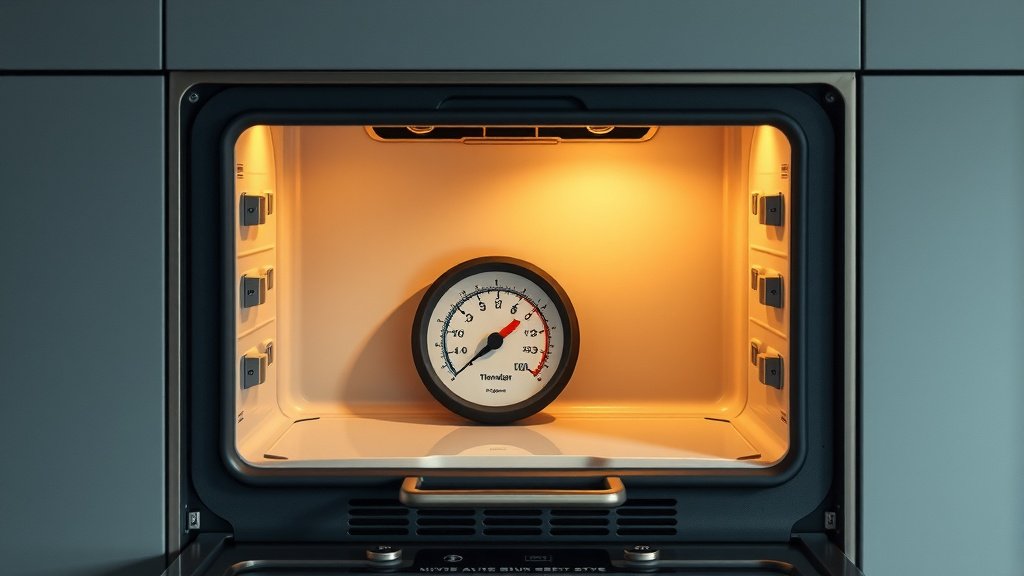
To calibrate a gas oven temperature, you often need to adjust the oven’s thermostat screw, usually found behind the temperature knob or inside the control panel. This adjustment helps fine-tune your oven’s heating accuracy for better cooking.
If your oven isn’t heating properly, adjusting its temperature calibration can bring it back to optimal performance, ensuring your dishes are consistently cooked to perfection.
- You can often fix an inaccurate gas oven temperature yourself.
- Start by testing your oven’s actual temperature with an oven thermometer.
- Adjust a hidden calibration screw to fine-tune the thermostat.
- Patience and small adjustments are key for accurate results.
- Regular checks ensure your cooking and baking are perfect every time.
Ever pull a cake from the oven, only to find it’s either burnt on the outside or still raw inside? Or maybe your roast chicken takes way longer than the recipe says? It is incredibly frustrating, right? Chances are, your oven temperature might be off.
A gas oven that is not heating accurately can cause a lot of cooking headaches. We want to help you fix this common issue. Let’s get your oven working like a pro again!
How To Calibrate A Gas Oven Temperature?
You can calibrate a gas oven by carefully adjusting the thermostat’s internal mechanism, often involving a small screw, after confirming the temperature deviation with an oven thermometer.
Why Does Oven Temperature Go Off-Kilter?
Ovens, like any appliance, can drift from their factory settings over time. Many experts say this is normal wear and tear (Appliance Service Association). Imagine a car’s speedometer needing a tweak after years of driving. Your oven’s thermostat is similar.
Small bumps, heating cycles, or even just age can affect how the sensor reads the temperature. This means what you set at 350°F might actually be 325°F or 375°F. That difference can ruin a soufflé!
What Happens When Your Oven Is Off?
If your oven runs too hot, food burns quickly on the outside. But it stays raw inside. If it runs too cold, things take ages to cook. Baking, in particular, becomes a guessing game. Precision is very important for baking.
Gathering Your Calibration Toolkit
Before we dive in, let’s collect a few essentials. You wouldn’t fix a leaky faucet without a wrench, would you? The right tools make this job much easier and safer for you.
- An accurate oven thermometer (must-have!).
- A screwdriver set (usually Phillips head or flathead).
- Your oven’s user manual (if you can find it).
- A little patience (you’ll need it!).
Why an Oven Thermometer is Essential
You might think your oven’s display is accurate. But we found that many built-in thermostats can be off by 25-50 degrees. An independent oven thermometer gives you the real picture. Place it in the center of the oven rack.
Testing Your Oven’s Current Temperature
This is the first and most critical step. You cannot fix what you do not measure! Think of it like taking your temperature when you feel sick. You need to know the actual reading.
Here’s what you do:
- Place your oven thermometer in the center of an empty oven rack.
- Close the oven door.
- Preheat your oven to a standard temperature, like 350°F (175°C).
- Let the oven preheat for at least 20 minutes after it signals it’s ready. Gas ovens need this extra time to stabilize their heat.
- After 20 minutes, open the door just enough to read the thermometer. Do not pull it out!
- Note the reading. Is it higher or lower than 350°F?
- Repeat this test at a few different temperatures, like 300°F and 400°F. This gives you a better average idea of the error.
Write down your findings. For example, if you set it to 350°F but the thermometer reads 375°F, your oven is running 25°F hot. This is your key piece of information.
Locating the Calibration Screw
This is where things can vary a bit. Your oven’s manual will be your best friend here. But generally, we found two main places where you might find the calibration screw.
Behind the Temperature Knob
For many older or simpler gas ovens, the calibration screw is right behind the temperature control knob. You will need to gently pull off the knob. Sometimes, a small plastic cap covers the screw. Remove that too.
Inside the Oven’s Control Panel
For more modern or complex ovens, you might need to access the main control panel. This usually involves removing a few screws around the panel’s edge. Always remember to turn off the power to your oven at the circuit breaker before doing this! Safety first!
The screw itself is often tiny. It might be labeled ‘CAL’ or look like a small brass screw. Many guidelines point to this screw as the primary way to adjust temperature (Appliance Repair Manuals).
How to Adjust the Calibration Screw
Now for the actual adjustment! This needs a delicate touch. Think of it like tuning a guitar string—small turns make a big difference.
Making Small Adjustments
Remember your thermometer reading? If your oven was running too hot, you need to turn the screw to make it cooler. If it was too cold, turn it to make it hotter. We found that:
- Turning the screw **clockwise** usually **decreases** the temperature.
- Turning the screw **counter-clockwise** usually **increases** the temperature.
Make a very small turn, perhaps an eighth or a quarter of a full rotation. Seriously, just a tiny bit!
Testing After Each Adjustment
After each small adjustment, put the knob back on (if you removed it) and re-test the oven temperature with your thermometer. Yes, this means another 20-minute wait. It is a bit like baking bread; patience pays off.
Keep adjusting in small increments and re-testing until your oven thermometer matches your desired set temperature as closely as possible. It might take a few tries. Don’t get discouraged!
Tips for Accurate Calibration
To make sure you get the best results, keep these pointers in mind:
| Tip | Explanation |
|---|---|
| Use a reliable thermometer | A cheap or old thermometer can give you wrong readings. Invest in a good one. |
| Give it time to stabilize | Allow your oven to preheat and stabilize for at least 20 minutes, or even longer for larger ovens. |
| Adjust in small steps | Over-adjusting will just make the process longer and more frustrating for you. |
| Check multiple temps | Calibrate at a common baking temperature, then check at higher and lower settings too. |
| Record your changes | Jot down what you did. “Turned screw clockwise 1/4 turn, temp dropped 10 degrees.” |
When to Call a Professional
Sometimes, despite your best efforts, the oven just won’t cooperate. If you have adjusted the screw several times and there is no change, or if you can’t find the screw, it might be time for expert help. Research often connects persistent temperature issues to a faulty thermostat or igniter (National Appliance Service Council).
You should consider calling a professional if:
- You cannot locate the calibration screw or the control panel access.
- The oven temperature is wildly off (more than 75°F) and small adjustments don’t help.
- The oven heats unevenly, with hot spots and cold spots.
- The oven fails to ignite or maintain a flame reliably.
- You feel uncomfortable with the DIY approach, especially dealing with gas and electrical components.
A Quick Safety Checklist
Working with appliances, especially gas ones, requires caution. Always prioritize your safety.
- Turn off the gas supply before working on internals.
- Disconnect power to the oven at the circuit breaker.
- Do not force anything; if a part feels stuck, seek help.
- Never bypass safety features.
- If you smell gas, turn off the supply and ventilate immediately.
Conclusion
Calibrating your gas oven’s temperature might seem daunting at first. But with a good oven thermometer and a bit of patience, you can often bring your oven back to peak performance. This simple adjustment can transform your cooking and baking results. Imagine perfectly golden-brown cookies or a roast cooked exactly as you planned!
We believe you have the ability to tackle this task. So, grab your tools, follow these steps, and enjoy the rewards of an accurately calibrated oven. Happy cooking!
What is a common reason for a gas oven to be inaccurate?
A common reason for a gas oven to be inaccurate is a thermostat that has drifted from its factory setting over time due to normal wear and tear, small bumps, or consistent heating cycles.
How often should I check my oven’s temperature for accuracy?
It is a good idea to check your oven’s temperature accuracy every six to twelve months, or if you notice any changes in how your food cooks, especially if you bake frequently.
Can a faulty igniter affect my oven’s temperature?
Yes, a faulty igniter can affect your oven’s temperature. If the igniter is weak or failing, it might not consistently light the burner, leading to uneven or insufficient heating and fluctuating temperatures.
Is it safe to calibrate my gas oven myself?
Calibrating your gas oven yourself can be safe if you follow instructions carefully, turn off the gas and electricity, and use proper tools. If you are unsure or uncomfortable, always call a qualified technician.
What is the typical cost for a professional oven calibration?
The typical cost for a professional oven calibration can vary depending on your location and the service provider, but it often ranges from $75 to $150. This usually covers the technician’s time and expertise to diagnose and adjust the thermostat.
