
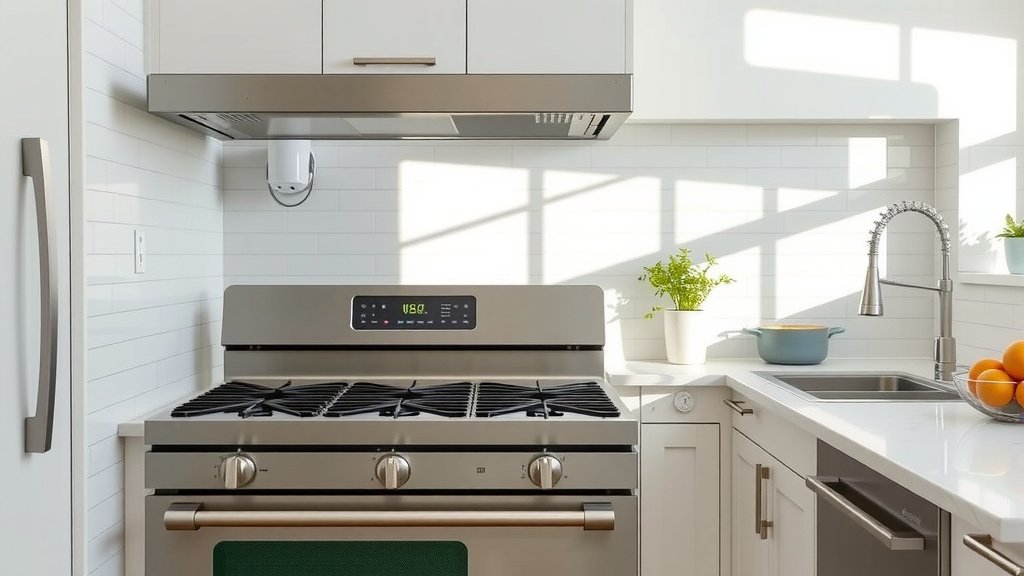
A typical gas oven uses between 10,000 to 20,000 BTUs (British Thermal Units) per hour, which roughly translates to 11 to 22 cubic feet of natural gas hourly, or about 0.11 to 0.22 therms.
This amount can vary significantly based on your oven’s efficiency, size, temperature setting, and how often you open the door, all impacting how much gas an oven uses per hour.
- A standard gas oven uses around 0.11 to 0.22 therms of natural gas per hour.
- Factors like oven size, temperature, and usage habits heavily influence gas consumption.
- Preheating is a major gas user; plan your cooking to minimize it.
- Regular cleaning and maintenance can boost your oven’s efficiency.
- Expect to pay anywhere from $0.10 to $0.40 per hour to run your gas oven, depending on local gas prices.
How Much Gas Does An Oven Use Per Hour?
Your gas oven is a kitchen workhorse, but have you ever wondered about its fuel appetite? On average, a residential gas oven typically burns between 10,000 to 20,000 BTUs (British Thermal Units) each hour it operates.
To put that into more tangible terms, we found that this usage equates to about 11 to 22 cubic feet of natural gas, or roughly 0.11 to 0.22 therms per hour.
Understanding BTU and Therms
BTU stands for British Thermal Unit. It is a measurement of heat energy. One BTU is the amount of heat needed to raise the temperature of one pound of water by one degree Fahrenheit.
Natural gas is often measured in therms for billing purposes. One therm is equivalent to 100,000 BTUs. So, a 15,000 BTU oven uses about 0.15 therms per hour.
What Impacts Your Oven’s Gas Usage?
Many factors contribute to how much gas your oven consumes. Thinking about these can help you manage your energy bill.
Oven Size and Model Matter
Larger ovens, understandably, require more gas to heat their greater interior volume. A commercial-grade oven will use far more than a standard home model. Newer ovens sometimes feature better insulation and efficiency ratings, burning less gas.
Temperature Settings
The higher the temperature you set, the more gas your oven will use. Roasting at 400°F will consume more energy than baking at 350°F. The oven works harder to maintain higher heat levels.
Preheating Habits
Preheating is one of the most gas-intensive phases of oven use. Your oven burns maximum gas to reach the set temperature quickly. Try to minimize excessive preheating time for optimal gas usage (U.S. Department of Energy).
Door Openings
Every time you open the oven door, a significant amount of heat escapes. The oven then has to work harder and burn more gas to regain that lost temperature. Using the oven light to check on food can save you gas.
Oven Maintenance and Age
An older oven with poor insulation or a faulty thermostat might be a gas guzzler. Regular cleaning of burner ports and ensuring the door seal is tight can boost efficiency.
Calculating Your Oven’s Gas Cost
Want to know the dollar amount? You can estimate your hourly cost fairly easily. First, you need to know your oven’s BTU rating, usually found in the owner’s manual or on a label near the door.
Then, find your local gas rate per therm. This information is available on your monthly gas bill. Gas prices often vary by region and season.
Finding Your Gas Rate
Let’s say your oven is 15,000 BTUs per hour, and your gas rate is $1.50 per therm. Since 1 therm is 100,000 BTUs, your oven uses 0.15 therms per hour. So, 0.15 therms * $1.50/therm = $0.225 per hour. It’s a simple multiplication task.
| Oven BTU Rating | Therms Used Per Hour | Estimated Cost Per Hour (at $1.50/therm) |
|---|---|---|
| 10,000 BTUs | 0.10 therms | $0.15 |
| 15,000 BTUs | 0.15 therms | $0.225 |
| 20,000 BTUs | 0.20 therms | $0.30 |
| 25,000 BTUs | 0.25 therms | $0.375 |
Gas vs. Electric Ovens: A Quick Look
While gas ovens typically cost less to operate per hour than electric ovens, it’s not always a clear winner. The cost comparison depends on your local utility rates for gas and electricity. Many experts say that gas ovens heat faster and provide moist heat, which is great for baking.
Electric ovens offer very consistent heat and often feature a broiler in the main oven cavity. Consider what you cook most and your local energy costs when choosing between the two.
Practical Ways to Reduce Gas Consumption
Saving gas in your oven use is like finding ways to make a pot of coffee last longer; it requires a little planning. You can make a real difference in your utility bill by adopting smart habits.
Smart Cooking Strategies
- Plan meals: Cook multiple dishes at once. Batch baking saves significant energy.
- Use smaller appliances: For small meals, a toaster oven or microwave uses less gas than your full-sized oven.
- Thaw food fully: Frozen items require more energy to cook.
- Choose proper bakeware: Glass or ceramic retain heat better, sometimes allowing lower temperatures.
- Turn off early: For dishes that cook quickly, turn off the oven a few minutes before the end; residual heat will finish the job.
Keeping Your Oven Efficient
Just like any appliance, your oven performs best when it’s well-maintained. A clean oven is an efficient oven. Food spills can absorb heat, making the oven work harder.
Many guidelines point to checking your oven door seal regularly (Energy Star). If the seal is cracked or loose, heat will escape, and your oven will use more gas to compensate. This is a simple fix.
Checking for Gas Leaks (Safety First!)
While discussing gas usage, it is important to mention safety. Natural gas is generally safe, but leaks can be extremely dangerous. Always be aware of the distinct sulfur smell of natural gas (often described as rotten eggs).
If you ever suspect a gas leak, turn off your oven and any other gas appliances immediately. Open windows and doors. Leave the house and call your gas company from a safe distance. Do not use light switches or anything that could spark.
Conclusion
Understanding how much gas your oven uses per hour helps you become a more energy-conscious cook. While a typical gas oven burns 0.11 to 0.22 therms hourly, this isn’t a fixed number. Your cooking habits, oven model, and maintenance play a huge part in the final bill.
By making small adjustments and keeping your oven in good shape, you can enjoy delicious meals without overspending on gas. It’s all about being informed and smart in the kitchen.
Are new gas ovens more efficient than older models?
Yes, often they are. Newer gas ovens generally come with better insulation, more precise temperature controls, and sometimes even features like convection baking, which can reduce cooking times and gas consumption. Upgrading can mean noticeable savings over time.
Does self-cleaning use a lot of gas?
Self-cleaning cycles do use a significant amount of gas. They heat the oven to extremely high temperatures (around 900°F) for several hours to burn off food residue. This process is energy-intensive, so it’s best to use it sparingly and strategically.
How can I tell if my oven is running inefficiently?
Signs of an inefficient oven include food taking longer to cook, a noticeable gas smell during operation (beyond the initial lighting), a flickering or yellow pilot light (if applicable), or a door that doesn’t seal properly. A qualified technician can assess these issues.
Is it cheaper to use a gas oven or a gas stovetop?
Generally, a gas stovetop uses less gas per hour than a gas oven. A single stovetop burner might use around 7,000-12,000 BTUs, while the entire oven cavity needs much more energy to heat up and maintain temperature. For quick tasks, the stovetop is usually more gas-efficient.
What’s the average lifespan of a gas oven?
With proper care and maintenance, a gas oven typically lasts between 13 to 15 years. Some models might even last longer. Factors like frequency of use, quality of the appliance, and consistent cleaning all contribute to its longevity.
