
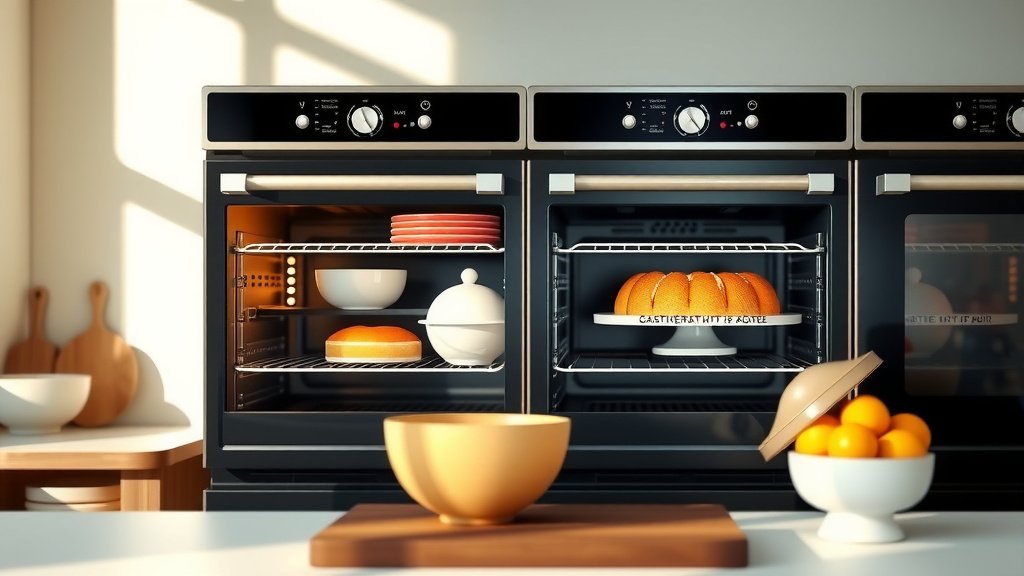
Baking cake in a double oven requires careful planning, using similar temperatures in both ovens, and strategic rack placement to ensure even heat distribution. You’ll want to preheat both ovens thoroughly and often bake cakes at the same temperature simultaneously.
To successfully bake a cake in a double oven, position your cakes on middle racks, ensure adequate space for air circulation, and monitor each oven independently for doneness to prevent over or underbaking.
TL;DR: Baking cakes in a double oven can be a real game-changer! Here’s the quick scoop:
- Preheat both ovens to the same temperature for consistency.
- Place cakes on middle racks, staggering them for good airflow.
- Monitor each cake independently; doneness times can vary slightly.
- Use oven thermometers to confirm actual temperatures.
- Don’t overcrowd; give your cakes room to breathe and bake evenly.
How To Bake Cake In A Double Oven?
Baking a cake in a double oven is often simpler than you might think, mainly because you can set both units to the exact same temperature. This allows for simultaneous baking with minimal adjustments.
The key is understanding your specific appliance and making a few smart choices about cake placement and monitoring.
Why a Double Oven is Your Baking Buddy
Having a double oven is like having an extra pair of hands in the kitchen. It’s perfect when you are hosting a party or simply craving multiple delicious cakes. You can bake different components of a meal at varying temperatures, or bake two identical items at the same temperature.
Imagine baking your main course in one oven while your delicate cake bakes beautifully in the other. It really opens up your baking possibilities, making your kitchen tasks much more efficient.
Upper Oven vs. Lower Oven: What’s the Difference?
While double ovens generally aim for consistency, there can be subtle differences between the upper and lower units. Many homeowners find that the upper oven sometimes heats a little faster or bakes a tad hotter due to its closer proximity to the top heating element (many sources, including consumer reports, mention this). The lower oven might retain heat slightly better. Getting to know your specific appliance’s quirks is helpful.
We found that using an independent oven thermometer in each chamber provides the most accurate reading. This simple tool helps you confirm if your set temperature matches the actual temperature inside.
Prepping for Double Oven Cake Success
Before you even mix your batter, a little preparation goes a long way. Think of it as laying the foundation for a perfectly baked cake. These steps ensure your ovens are ready for their dual duty.
Calibrating Your Ovens
Are your ovens truly running at the temperature you set? Many experts say oven thermostats can drift over time. This means 350°F on the dial might be 330°F or 370°F inside.
To calibrate, place an oven thermometer in each oven and compare its reading to the oven’s display. If there’s a consistent difference, you’ll know to adjust your recipe temperature accordingly. For instance, if your oven reads 375°F but your thermometer says 350°F, you will want to adjust your recipe to set at 375°F.
Choosing the Right Baking Pans
Consistency in baking often starts with consistent equipment. Using pans of similar material, size, and color for multiple cakes helps them bake at the same rate. Darker pans tend to absorb more heat, often leading to darker crusts and sometimes faster baking times. Lighter, reflective pans might bake slower.
If you’re baking two identical cakes, try to use two identical pans. This small detail can make a big difference in the final product.
The Art of Cake Placement in a Double Oven
Where you put your cakes inside the oven matters a lot for even baking. It’s not just about fitting them in; it’s about giving them the best environment to rise and brown beautifully.
Staggering Your Cakes
When baking two cakes, try not to place them directly above or beside each other if possible. If you are baking in two separate ovens, this is easier. If you are trying to bake two cakes in one oven (not recommended for double oven purposes, but for illustration), staggering them on different racks can help. For double ovens, place one cake in the center of the middle rack of the upper oven, and the other in the center of the middle rack of the lower oven.
This approach allows heat to circulate freely around each cake, encouraging even baking and browning. It avoids creating “hot spots” or “cold spots” where one cake might block heat from reaching another.
Airflow is Key
Think of your oven as a convection current – hot air needs to move freely to cook everything evenly. Don’t crowd your cakes. Leave at least a few inches between pans and the oven walls, as well as between pans if they are sharing a rack (which is less likely in a double oven scenario but good to remember). Proper airflow ensures that all sides of your cake receive consistent heat, leading to a much better texture and rise.
Temperature Control: A Balancing Act
Getting the temperature just right is critical for any cake. With a double oven, you have the advantage of precise control over two distinct baking environments.
Same Temperature, Different Ovens?
For most cake recipes, you will want to set both ovens to the same temperature. This creates a predictable environment for both cakes. While some double ovens allow different temperatures, keeping them the same for identical cakes helps simplify the process.
Many home bakers find this strategy yields consistent results. It helps prevent one cake from baking too quickly while the other lags behind.
Adjusting for Multiple Cakes
Sometimes, baking multiple items can slightly reduce the overall oven temperature or increase baking time. It is important to note that this impact is minimal when using two separate ovens. Each oven is heating a single cake, allowing it to maintain its set temperature more effectively. We found that the bake time often remains quite similar to baking a single cake (Cook’s Illustrated). However, always keep an eye on your cakes and trust your judgment.
| Cake Type | Typical Single Oven Temp. | Double Oven Strategy |
|---|---|---|
| Vanilla Sponge | 350°F (175°C) | Both ovens at 350°F (175°C), middle racks. |
| Chocolate Fudge | 325°F (160°C) | Both ovens at 325°F (160°C), middle racks. |
| Lemon Drizzle | 350°F (175°C) | Both ovens at 350°F (175°C), middle racks. |
| Carrot Cake | 350°F (175°C) | Both ovens at 350°F (175°C), middle racks. |
Timing Your Cakes Perfectly
Even with two ovens, timing is still the baker’s biggest friend and sometimes, biggest challenge. Each cake might behave slightly differently, so monitoring is key.
Checking for Doneness
Don’t rely solely on the recipe’s suggested baking time when baking two cakes. Begin checking about 5-10 minutes before the minimum recommended time. Insert a clean toothpick into the center of each cake; if it comes out clean, your cake is likely done. The cake edges should pull away slightly from the pan, and the top should spring back when gently pressed. Check each cake individually, as one might finish before the other.
Rotating Cakes: Yes or No?
If you notice one cake browning more quickly on one side, a quick rotation (halfway through baking, if necessary) can help even things out. However, if your ovens are properly calibrated and your cakes are positioned well, rotating might not be needed. Opening the oven door too often lets out heat, potentially affecting the final texture of your cake.
- Preheat Both Ovens: Set to the same temperature and let them fully heat up.
- Use Oven Thermometers: Confirm actual temperatures in each oven.
- Stagger Cake Placement: Middle racks, central positions, no blocking.
- Use Similar Pans: Helps ensure even baking times.
- Check Individually: Cakes may finish at different times.
Common Double Oven Cake Baking Challenges
Even seasoned bakers encounter hiccups. Knowing what to look for and how to respond makes all the difference. Baking two cakes at once in a double oven can present its own set of minor challenges.
Uneven Browning Solutions
If one cake is browning faster on top, or one side, it might be due to a hot spot in that particular oven. Try covering the browning area loosely with aluminum foil. If one oven consistently browns unevenly, you might consider adjusting the rack position slightly for future bakes. An oven thermometer will help you confirm if one oven is simply running hotter.
Dealing with Cracks or Sinking
Cracks can sometimes mean your oven was a little too hot, causing the outside to set too quickly while the inside continues to expand. Sinking often suggests it was removed from the oven too early or that the leavening agent wasn’t strong enough. Make sure your oven is at the correct temperature using a thermometer, and resist opening the door too early during baking. These issues are generally related to the recipe or temperature, not typically the fact you are using two ovens.
Pro Tips from Baking Enthusiasts
Many baking enthusiasts suggest always using an oven thermometer, even if your oven is brand new. They also advise against baking wildly different items in the same oven, as moisture and temperature needs can clash. For cakes, keeping it consistent across both ovens is generally the best plan. Some bakers also swear by giving their cake batter a 10-minute rest before pouring into pans, believing it helps create a finer crumb texture.
Conclusion
Baking cakes in a double oven isn’t just about doubling your output; it’s about making your baking process more flexible and efficient. By understanding your oven’s nuances, properly positioning your cakes, and carefully managing temperatures, you can consistently achieve beautifully baked results.
Don’t be afraid to experiment with your double oven. With each batch, you’ll grow more confident and discover just how much of a baking powerhouse it can be. Happy baking!
Can I bake different types of cakes at once?
You can bake different types of cakes at once if they require the same oven temperature and a similar baking time range. For example, two different flavored sponge cakes baking at 350°F would work well. If one needs 325°F and the other 375°F, it’s best to bake them separately in each oven if your model allows different temperature settings, or at different times.
Should I preheat both ovens for one cake?
If you are only baking one cake, you only need to preheat the oven you plan to use for that cake. Preheating both ovens for a single item would use unnecessary energy. Always choose the oven that best suits your needs for that specific bake.
What if my double oven has different sizes?
Some double ovens feature one larger and one smaller cavity. If this is your case, use the oven that best fits your cake pan with adequate space around it for air circulation. A larger pan in a smaller oven could lead to uneven baking. Always ensure there’s enough room for heat to move freely.
How do I prevent my cakes from drying out?
To prevent cakes from drying out, avoid overbaking by checking for doneness at the minimum recommended time. Ensure your oven temperature is accurate with a thermometer to prevent baking hotter than intended. Also, make sure your recipe has the correct ratio of wet to dry ingredients, and avoid opening the oven door too frequently, as this causes temperature fluctuations.
Is it okay to open the oven door during baking?
It’s generally best to avoid opening the oven door too often, especially during the first two-thirds of the baking time. Opening the door causes a significant drop in oven temperature, which can affect the cake’s rise and texture, sometimes causing it to sink. Only open the door when necessary to check for doneness or rotate (if needed), and do it quickly.
