
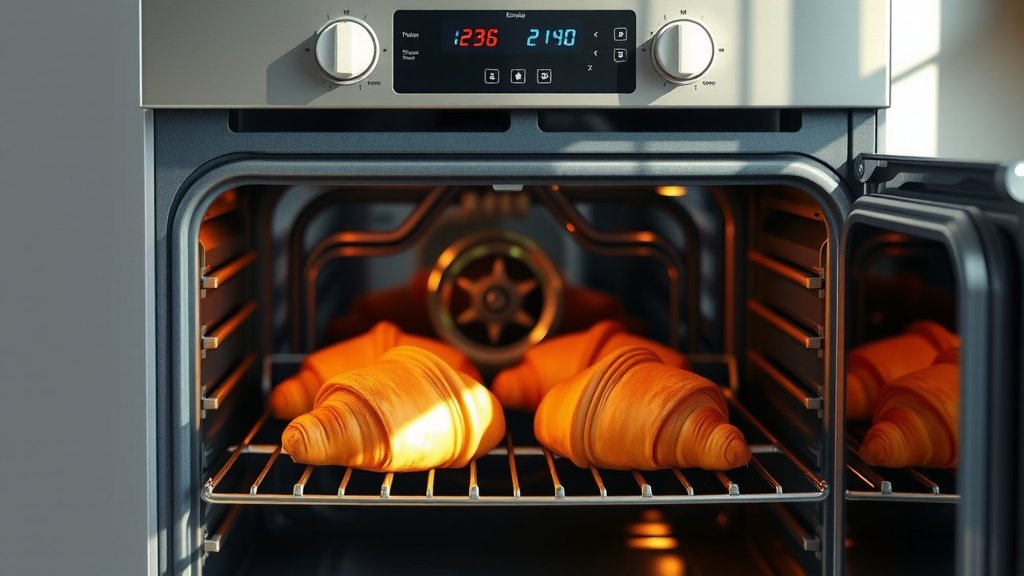
Making croissants in a gas oven involves understanding its unique heating patterns and adjusting your technique for even baking and a beautiful golden crust.
You’ll need to master temperature control and possibly use baking stones or steel to counteract common gas oven hot spots.
Here’s a quick overview of what you’ll find in this guide:
- Discover how to tackle common gas oven quirks to achieve perfect croissant layers.
- Learn about the best temperatures and times for gas oven baking.
- Get tips on managing humidity and avoiding dry, tough croissants.
- Find out which tools can help you bake like a pro at home.
- Understand how to troubleshoot for a flaky, airy finish every time.
How To Make Croissants In A Gas Oven?
To make croissants in a gas oven, you typically preheat your oven to a slightly higher temperature, then reduce it once the croissants are in, using a baking stone or steel for better heat distribution.
Monitoring for hot spots and rotating your tray are also key steps for even browning.
Understanding Your Gas Oven’s Personality
Every oven has its own quirks, like a picky eater. Gas ovens, we’ve found, often have a more aggressive bottom heat element.
This can lead to one side or the bottom of your croissants browning much faster than the top (Food Network Kitchen).
The Heat Distribution Challenge
Think of your gas oven as a cozy campfire; it’s warm but not perfectly uniform. Research shows that gas ovens often have areas that are hotter than others.
This uneven heat means your beautiful croissant dough might bake inconsistently if you don’t take precautions.
Prepping Your Croissant Dough: The Foundation
Even with a gas oven, the journey to a perfect croissant starts long before baking. Your dough needs patience, precision, and proper lamination.
This careful preparation ensures you give your oven the best possible canvas to work with.
The Lamination Dance
Lamination is like folding a delicate blanket, trapping air and butter. You’re creating those many layers that give croissants their signature flakiness.
Cold butter and cold dough are your best friends here; warmth will ruin the layers.
Many experts say that ensuring your dough is properly chilled between folds prevents the butter from melting out.
This is a critical step for that airy, tender crumb (Le Cordon Bleu). What happens if the butter melts? You lose your layers, simple as that.
Oven Setup for Croissant Success
Getting your gas oven ready is half the battle. You want to create an environment that promotes even baking and a fantastic rise.
This often means thinking beyond just setting a temperature knob.
Utilizing a Baking Stone or Steel
A baking stone or steel acts as a thermal buffer, evening out the oven’s heat. Place it on the lowest or middle rack during preheating.
It absorbs and radiates heat steadily, helping to prevent burnt bottoms and ensure a more even bake (Cook’s Illustrated).
Placement Matters
Where you put your baking sheet can drastically change results. We found that the middle rack usually works best for croissants.
If you’re using a baking stone, place your croissants directly on it, or on a parchment-lined baking sheet on the stone.
Baking Temperatures and Times: A Gas Oven Guide
This is where gas ovens really ask for your attention. The standard recipe might call for one temperature, but your gas oven might need a tweak.
Let’s find the sweet spot for those golden-brown beauties.
| Baking Phase | Conventional Electric Oven Temp | Recommended Gas Oven Temp Adjustment | Time |
|---|---|---|---|
| Initial Bake (High Heat) | 400-425°F (200-220°C) | Start at 425-450°F (220-230°C) | 10-15 minutes |
| Second Bake (Lower Heat) | 375-385°F (190-195°C) | Reduce to 375-385°F (190-195°C) | 15-20 minutes |
Starting with a higher initial temperature helps with a rapid rise, often called “oven spring.” Then, lowering the heat prevents burning and allows the inside to cook through.
Always keep an eye on your croissants, as every oven is different, even among gas models.
Dealing with Gas Oven Challenges
You’re baking, and suddenly you notice uneven browning or a lack of crispness. Don’t worry, these are common gas oven stories.
We’ve got some practical solutions to keep your croissants on track.
Tackling Hot Spots and Uneven Browning
Have you ever baked cookies and seen some burnt while others were pale? That’s hot spots at play. For croissants, this means rotating your tray.
Rotate your baking sheet halfway through the baking process, perhaps after 10-15 minutes.
You might even need to turn individual croissants if one side is getting too much heat (Culinary Institute of America). A little rotation can go a long way.
Moisture and Crispness: A Balancing Act
Gas ovens can be drier than electric ovens due to the combustion process. This can lead to a less crisp crust or dry interiors.
Some bakers introduce a small pan of hot water to the bottom of the oven during the first few minutes of baking.
However, be cautious; too much steam can prevent browning. Experiment with a small, shallow dish of water for just the first 5-7 minutes.
The Egg Wash Magic
Don’t skip the egg wash! It’s like applying a magic potion for color and shine. A simple egg wash makes all the difference.
It gives your croissants that inviting, glossy, golden-brown finish.
We found that a mixture of one egg yolk with a splash of milk or water works best. Brush it on gently, just before baking, for an even coat.
This thin layer caramelizes beautifully, adding both flavor and visual appeal to your croissants.
Post-Bake Care: Cooling for Perfection
Your croissants are out of the oven, smelling incredible. But the journey isn’t over yet! Proper cooling is vital for texture.
Resist the urge to tear into them right away, as tempting as it is.
Allow your croissants to cool on a wire rack for at least 30 minutes. This lets the steam escape and the crust crisp up fully.
Cutting into them too soon can make them dense or gummy inside (King Arthur Baking Company).
Your Croissant Checklist for Gas Ovens:
- Preheat thoroughly: Let your gas oven heat for an extra 15-20 minutes beyond the indicator light.
- Use a baking stone/steel: Place it on the middle or lower rack.
- Monitor closely: Watch for hot spots and adjust accordingly.
- Rotate baking sheet: Turn your tray halfway through baking.
- Consider a water pan: For added moisture in the first few minutes, if needed.
- Cool completely: Allow croissants to cool on a wire rack for proper texture.
Conclusion
Making delicious croissants in a gas oven is absolutely achievable, even if it requires a bit more attention than an electric one. By understanding your oven’s unique heating, adjusting temperatures, and utilizing tools like baking stones, you can overcome common challenges.
The key is patience and observation. With these tips and a little practice, you’ll be pulling out beautifully golden, flaky croissants that will impress everyone, especially yourself. Happy baking!
Can I use parchment paper directly on a baking stone in a gas oven?
Yes, you can absolutely use parchment paper on your baking stone or steel in a gas oven. This helps prevent sticking and makes cleanup easier. The parchment paper will not interfere with the heat distribution benefits of the stone.
How do I know if my gas oven has hot spots?
A simple way to test for hot spots is to bake a tray of plain toast or sugar cookies. Observe which areas brown faster or unevenly. This will give you a visual map of where your oven runs hotter, guiding your rotation strategy for croissants.
What’s the best way to store homemade croissants?
For best results, store freshly baked croissants at room temperature in an airtight container for up to two days. If you plan to keep them longer, freezing them in a freezer-safe bag after they’ve cooled completely works well. Reheat frozen croissants in a moderate oven for a few minutes.
Can I proof croissants in a gas oven with the pilot light on?
You can proof croissants in a gas oven, but be careful with the pilot light. Some pilot lights generate enough warmth to be ideal for proofing. However, others might be too hot and cause the butter to melt out of the dough. Always check the temperature inside first; it should feel just slightly warm to the touch, around 75-80°F (24-27°C).
My croissants are browning too quickly on the bottom. What should I do?
If your croissant bottoms are browning too fast in a gas oven, try moving your baking stone or steel up one rack position. You can also place an empty baking sheet on the lowest rack to act as a shield, deflecting some of that direct bottom heat. Another option is to use a lighter-colored baking sheet, as dark pans absorb more heat.
