
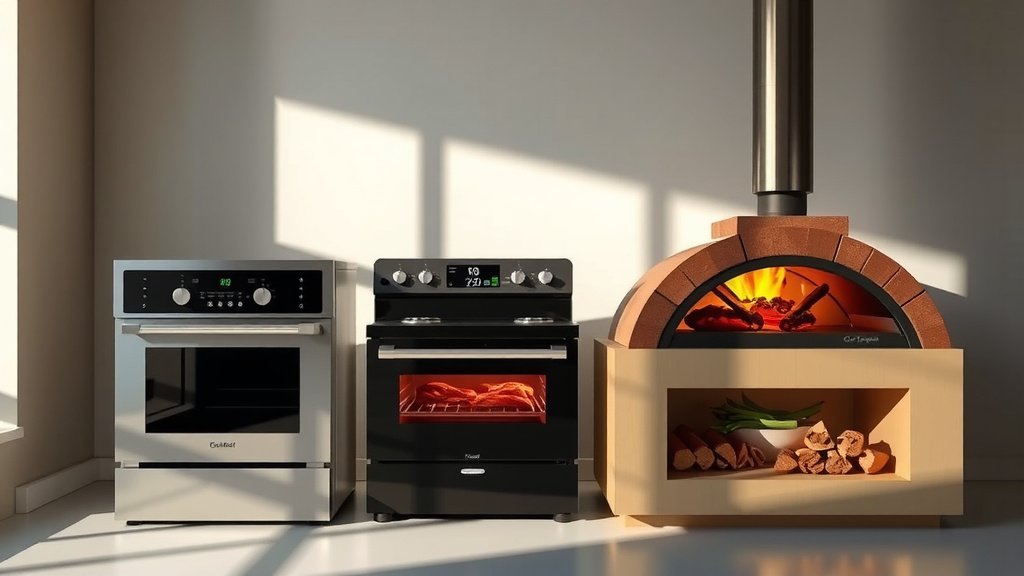
The main difference between all types of ovens lies in their heat source and how they distribute that heat, leading to distinct cooking methods and results for your dishes.
Understanding these variations helps you pick the right oven, whether you need consistent baking, quick roasting, or specialized cooking for specific foods.
Here’s a quick overview of what you’ll learn:
- Conventional ovens use radiant heat, while convection ovens add a fan for even air circulation.
- Gas ovens often provide moist heat, making them good for roasts, but electric ovens offer more precise temperature control.
- Wall ovens save space and fit modern kitchens, whereas range ovens combine the cooktop and oven in one unit.
- Specialty ovens, like steam or speed ovens, bring unique cooking advantages for specific culinary needs.
What Is The Difference Between All Types Of Ovens?
The primary differences among oven types stem from their heating mechanism and airflow, which directly impact cooking performance and food texture.
Some use direct heat, others circulate hot air, and some even combine methods to offer unique kitchen capabilities.
The Basic Players: Conventional vs. Convection Ovens
When you think about ovens, these two are often the first that come to mind. They form the foundation of most home kitchens.
A conventional oven relies on radiant heat from heating elements at the top and bottom. Heat rises naturally, meaning the top of your oven is usually hotter than the bottom.
This method is tried and true for many recipes, offering a more traditional bake. You might need to rotate your dishes for even browning.
On the other hand, a convection oven introduces a fan to circulate hot air evenly throughout the cavity. This circulating air surrounds your food, cooking it faster and more consistently.
Many experts say convection can reduce cooking times and create a crispier exterior on items like roasted chicken or vegetables (USDA).
Digging Deeper: Gas vs. Electric Ovens
Beyond how heat moves, the energy source also matters a lot. Are you a gas or an electric person?
Gas ovens use a gas burner to generate heat, often producing a moister cooking environment. Many home cooks find this ideal for roasts and casseroles, preventing them from drying out.
Running a gas oven can be more cost-effective in some areas, we found, compared to electric models over time.
Electric ovens rely on electric heating elements, providing a drier heat and generally more precise temperature control. Bakers often prefer electric ovens for consistent browning and predictable results.
These ovens usually heat up a bit slower but maintain a very stable temperature throughout the cooking process.
Which Oven Type Fits Your Cooking Style?
Your choice often comes down to what you cook most. Do you value precise baking or a moist roasting environment?
Consider your utility costs and whether you have a gas line available in your kitchen, which can also steer your decision.
Wall Ovens vs. Range Ovens: Space and Style
Where your oven sits in your kitchen is another big factor. Do you like a standalone unit or one built into your cabinetry?
A range oven combines the cooktop and oven into a single, integrated unit. This is the most common setup in many homes and is a space-efficient choice for smaller kitchens.
It’s an all-in-one appliance, offering both surface cooking and baking capabilities.
Wall ovens are built directly into your kitchen cabinetry at eye level. This design offers a sleek, modern look and can be much more ergonomic, reducing bending over.
You can also pair a wall oven with a separate cooktop, allowing for flexible kitchen layouts and design.
Double Ovens: For the Multitasker
Imagine cooking your main dish and a side at different temperatures simultaneously. That’s the magic of double ovens.
These can be stacked wall ovens or a single range unit with two separate oven cavities. It’s a real time-saver for large meals or entertaining guests.
Microwave Ovens: Quick Heating Champion
While not for baking in the traditional sense, the microwave oven is an undeniable kitchen staple. It uses electromagnetic radiation to heat food rapidly.
It’s perfect for reheating leftovers, defrosting ingredients, and quick cooking tasks, though it won’t give you that crispy, browned finish.
Speed Ovens: Combining Technologies
What if you could have the best of both worlds? Speed ovens combine microwave technology with convection heat.
This means your food cooks incredibly fast while still achieving browning and crispness. It’s a fantastic option for those who value efficiency.
Steam Ovens: For Healthier Cooking
Steam ovens cook food using, you guessed it, steam! This method helps to lock in moisture and nutrients, producing incredibly tender and flavorful results.
Research suggests steam cooking can preserve more vitamins and minerals compared to other methods (NIH). It’s a great choice for vegetables, fish, and even baking bread with a beautiful crust.
Pizza Ovens: High Heat for Crispy Crusts
For the pizza lovers, a dedicated pizza oven reaches extremely high temperatures, far beyond a conventional home oven. This intense heat creates that perfect, charred, and crispy crust in minutes.
While often outdoor units, smaller countertop electric models also exist for true pizza enthusiasts.
Oven Comparison at a Glance
Here’s a quick table to help you compare the main oven types side-by-side:
| Oven Type | Heat Source | Best For | Key Feature |
|---|---|---|---|
| Conventional | Radiant heat | Traditional baking, roasting | Simple, familiar operation |
| Convection | Fan-circulated heat | Even baking, crisping, faster cooking | Faster, more consistent results |
| Gas | Gas burner | Moist dishes, roasts, casseroles | Moist heat, often lower running cost |
| Electric | Electric elements | Precise baking, browning, dehydrating | Precise temperature control |
| Steam | Water vapor (steam) | Vegetables, fish, bread, reheating | Preserves nutrients, moist cooking |
| Speed | Microwave + Convection | Fast cooking, browning | Combines speed with traditional results |
Choosing Your Perfect Oven: A Quick Checklist
Feeling overwhelmed? Use this checklist to narrow down your options and find the oven that truly suits your home and cooking habits:
- What is your primary cooking style? (Baking, roasting, quick meals, healthy steaming?)
- Do you need precise temperature control or prefer moist heat?
- What type of energy supply do you have? (Gas line, electrical capacity?)
- How much kitchen space is available, and what design aesthetic do you prefer?
- Do you entertain often or cook large meals? (Consider double ovens or larger capacity.)
- What is your budget for both purchase and running costs?
Why Does Oven Type Matter So Much?
Choosing the right oven is more than just picking an appliance; it’s about enhancing your entire cooking experience. The type of oven you have directly influences the quality of your food, your kitchen’s efficiency, and even your utility bills.
Understanding these differences helps you make a truly informed decision, one that supports your culinary aspirations and daily kitchen flow. It’s about finding the right tool for your specific cooking adventures.
Conclusion
Ultimately, the difference between all types of ovens boils down to their heating methods and what they can do for your food. From the consistent browning of a convection oven to the speedy warmth of a microwave, each type brings something unique to the table. By understanding these distinctions, you’re better equipped to select an oven that perfectly matches your cooking style, kitchen needs, and even your energy preferences.
FAQs About Oven Types
What is the most energy-efficient type of oven?
Generally, electric convection ovens are considered very energy-efficient because the fan circulates hot air, reducing cooking times and often allowing for lower cooking temperatures. Many experts say a well-insulated oven also helps save energy (Energy Star).
Can I bake in a gas oven as well as an electric oven?
Yes, you can certainly bake in a gas oven. Gas ovens tend to have a moister heat, which can be great for certain baked goods like cakes or roasts. Electric ovens, with their drier, more consistent heat, are often preferred for things like delicate pastries or cookies where precise browning is key.
Is it possible to convert a gas oven to electric, or vice versa?
Converting an existing oven from gas to electric or electric to gas is typically not feasible or recommended. It usually involves changing the entire appliance and requires specific utility hookups (gas line vs. dedicated electrical circuit) that are expensive and complex to install.
What are common signs that my oven isn’t heating correctly?
If your oven isn’t heating correctly, you might notice food taking much longer to cook, uneven browning, or the oven not reaching the set temperature. We found that cold spots inside the oven or the oven light staying on longer than usual can also be indicators of an issue with the heating elements or thermostat.
Are there ovens that combine multiple cooking technologies?
Absolutely! Speed ovens combine microwave and convection cooking, offering fast and thorough results. There are also combo steam-convection ovens that provide the benefits of both moist steam cooking and even convection heat, perfect for versatile chefs.
