
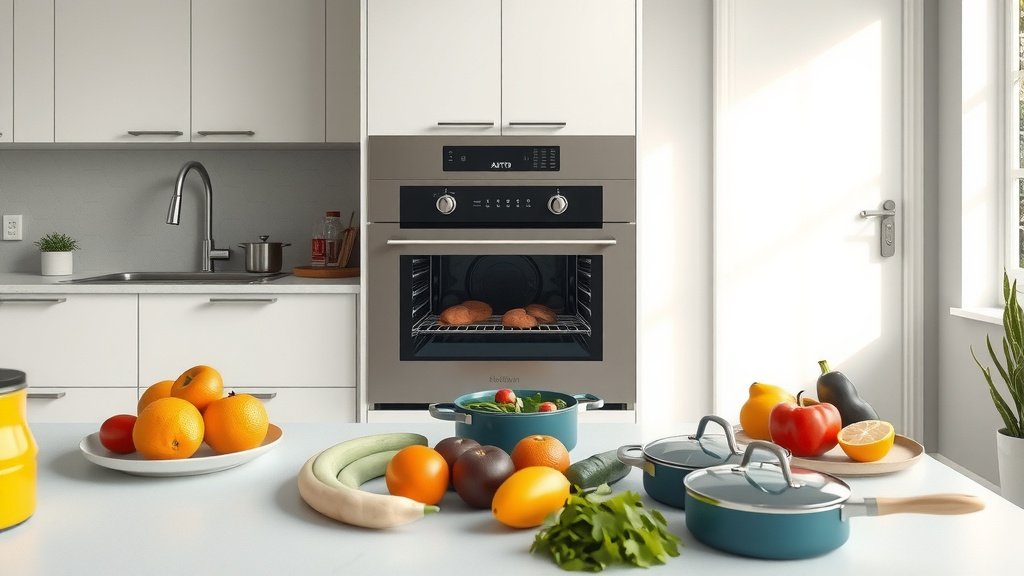
For cooking large meals, a convection oven is often best because its fan circulates hot air, ensuring even cooking and faster results across multiple dishes.
This even heating prevents hot spots, making it ideal for roasting big turkeys, baking multiple trays of cookies, or preparing an entire holiday feast efficiently.
- A convection oven uses a fan to circulate hot air for even cooking.
- It cooks food faster and more uniformly than traditional ovens.
- Look for large internal capacity and multiple rack positions for big meals.
- Consider features like self-cleaning and smooth-gliding racks for convenience.
- Both gas and electric convection models offer great results, depending on your preference.
What Oven Type Is Best For Cooking Large Meals?
The convection oven stands out as the superior choice for cooking large meals. Its unique design ensures your big roasts and multiple side dishes cook perfectly every time.
Why Convection Wins for Big Dinners
Imagine cooking a huge turkey or several casseroles simultaneously. A convection oven makes this possible with remarkably even heat distribution. No more burnt edges and undercooked centers!
We found that convection ovens also cook food up to 25% faster than conventional models. This means less waiting and more enjoying your delicious, large meal (USDA).
How Convection Works Its Magic
What’s the secret? A convection oven has a fan inside that actively moves hot air around the cavity. This circulation eliminates cold spots and ensures that heat reaches every part of your food.
Think of it like a warm breeze gently cooking your meal from all sides. This consistent airflow is why your holiday ham can brown beautifully and cook thoroughly.
Understanding Your Oven Options
While convection is often preferred, it’s good to know other oven types too. Each has its strengths and weaknesses, especially when tackling a large family dinner.
Conventional Ovens: The Classic Choice
The conventional oven is what most of us grew up with. It heats from stationary elements, usually at the top and bottom. Heat rises naturally, which can create temperature differences.
For large meals, this means you might need to rotate dishes or swap rack positions. It still works, but requires more attention to get even results (Food Network).
Steam Ovens: A Niche, But Powerful Player
Steam ovens cook food using, you guessed it, steam! They are fantastic for keeping food moist and reheating leftovers without drying them out. They cook quickly too.
However, many steam ovens have smaller capacities. While great for a single large fish or some vegetables, they might not fit your entire holiday feast. Some larger combination steam ovens do exist, offering both steam and convection.
Key Features to Look For When Cooking Big
When you’re feeding a crowd, the oven’s features become really important. You want it to make your life easier, not harder.
Size Matters: Internal Capacity
A big oven cavity is non-negotiable for large meals. Look for ovens with at least 5.0 cubic feet of capacity, or even larger if you often cook multiple items.
This extra space allows for larger roasting pans and ensures proper air circulation around your dishes, which is especially important for convection.
Multiple Racks for Multiple Dishes
Can you cook your turkey, roasted potatoes, and green bean casserole all at once? Check if the oven has three or more adjustable racks. This flexibility is a game-changer for holiday cooking.
Adjustable racks mean you can customize the interior space to fit tall roasts or multiple flat baking sheets. We found this to be a top priority for busy chefs (Good Housekeeping).
Self-Cleaning: A Post-Feast Friend
After a big meal, cleaning the oven is the last thing you want to do. A self-cleaning feature uses high heat to burn away food residue, turning it to ash. This makes cleanup a breeze.
This practical feature saves you scrubbing time, letting you relax and enjoy the company after dinner. It’s a small detail that offers huge relief.
Smooth Gliding Racks for Heavy Dishes
Ever tried to pull out a heavy roasting pan filled with a 20-pound turkey? It can be tricky! Some ovens feature racks that glide out smoothly on ball bearings.
This small addition makes it safer and easier to check on, baste, or remove heavy dishes without struggling. Many experts say this feature is worth the investment for safety and convenience.
Gas vs. Electric: Which Fuel for Your Feast?
Both gas and electric ovens can be excellent, especially with convection. Your choice often comes down to personal preference and what’s available in your home.
Gas Ovens: Quick Heat, Moist Results
Gas ovens often heat up faster and create a slightly more moist environment. This can be fantastic for roasting meats that you want to keep juicy, like a tender prime rib.
Many chefs prefer gas for its intense heat, which can create a nice crust on certain dishes. Just be sure to find a gas model with robust convection capabilities.
Electric Ovens: Consistent, Even Heat
Electric ovens are known for their consistent and precise temperatures. This steady heat is often favored for baking, where accuracy really matters.
For large meals, an electric convection oven provides very reliable and even cooking throughout the entire cavity. We found that electric models often pair very well with convection fans (Consumer Reports).
Preparing Your Oven for a Large Cook
Even with the best oven, a little preparation goes a long way. These simple steps ensure your big meal cooks perfectly.
Preheating Is Your Best Friend
Always preheat your oven completely. Don’t rush this step. A fully preheated oven ensures that your food starts cooking at the correct temperature from the very first minute.
For large roasts, some experts recommend preheating for an extra 10-15 minutes beyond the indicator light. This ensures the oven walls are fully saturated with heat.
Don’t Overcrowd the Oven
It’s tempting to cram everything in, but resist the urge. Overcrowding blocks the airflow, especially in a convection oven. This leads to uneven cooking and longer cook times.
Give your dishes some breathing room. If you need more space, cook in batches or use two ovens if you have them.
Calibrate Your Oven for Accuracy
Is your oven truly hitting the temperature it says? Oven temperatures can drift over time. Use an oven thermometer to check for accuracy.
If your oven is off, you might be able to recalibrate it (check your manual) or just adjust your recipes accordingly. Many guidelines point to a temperature check as a good first step for consistent cooking (Mayo Clinic).
The Best Oven Types for Cooking Large Meals: A Quick Comparison
| Oven Type | Pros for Large Meals | Cons for Large Meals |
|---|---|---|
| Convection Oven | Even cooking, faster cooking, browns well, ideal for multiple dishes. | Can dry out delicate foods if not adjusted, higher cost. |
| Conventional Oven | Familiar, generally lower cost. | Uneven heating, requires dish rotation, slower cooking. |
| Steam Oven | Moist results, quick cooking for certain items. | Often smaller capacity, less versatile for large, mixed meals. |
Making Your Choice: A Checklist
Choosing the right oven can feel like a big decision. Here’s a simple checklist to guide you towards the best oven for your large meal ambitions:
- Do you frequently host big dinners or bake large batches?
- Is even, consistent cooking your top priority?
- Are you looking to reduce cooking times?
- Do you need maximum internal capacity and multiple rack positions?
- Is convenient cleanup important to you?
Conclusion
When it comes to cooking large meals, the convection oven is truly your best friend. Its ability to circulate hot air evenly and cook faster makes it an unbeatable choice for big gatherings and holiday feasts.
Remember to consider features like internal capacity, multiple racks, and self-cleaning options. Whether you pick gas or electric, a convection model will help you prepare delicious, perfectly cooked meals with less stress. Happy cooking!
What is the main benefit of a convection oven for large meals?
The main benefit is its ability to cook food evenly and more quickly. The fan-forced air circulation eliminates hot and cold spots, ensuring that even large items like turkeys or multiple trays of cookies cook uniformly without needing to be rotated.
Can I cook multiple dishes at different temperatures in a convection oven?
While a convection oven cooks more evenly, it’s still best to cook dishes that require similar temperatures. The circulating air will distribute heat, but significant temperature differences between dishes will affect their cooking times and results. Prioritize dishes that can share a temperature range.
Are convection ovens harder to use than conventional ovens?
Not at all! Many modern convection ovens have simple settings. You might just need to reduce the cooking temperature by about 25 degrees Fahrenheit or shorten the cooking time slightly for recipes written for conventional ovens. Your oven manual will offer specific guidance.
Does a larger oven mean better cooking for big items?
Yes, generally a larger internal capacity is better for big items. More space allows for bigger roasting pans and, crucially, ensures adequate airflow around your food. This airflow is vital for the even cooking that makes convection so effective.
Should I use convection for all types of large meals?
Convection is excellent for most large meals, especially roasting meats, baking casseroles, or preparing multiple trays of baked goods. However, for very delicate items or things that need to rise a lot (like certain soufflés), some people prefer conventional baking to avoid too much drying or uneven rising.
